Discover how precision-guided steroid injections can resolve chronic foot pain and whether this specialist treatment in North Yorkshire is the right alternative to surgery for you.
For residents across North Yorkshire and the Tees Valley, persistent foot pain can be a debilitating barrier to an active life. When rest, ice, and new insoles fail to provide lasting relief, the path forward can seem unclear. You may be frustrated with generic advice, anxious about the prospect of major surgery, and wondering if there is a more direct route to recovery.
A corticosteroid injection, when administered by a specialist, is far more than a temporary fix. It is a powerful diagnostic and therapeutic tool that can significantly reduce inflammation, alleviate pain, and, in many cases, help you avoid an operation altogether. This guide explains how steroid injections work, who they are for, and what to expect from your treatment with Consultant Orthopaedic Surgeon Mr Ramsay Refaie.
Understanding Steroid Injections for Foot Pain in North Yorkshire
A corticosteroid injection is a minimally invasive procedure that delivers a potent anti-inflammatory medication directly to the source of your pain. Unlike oral steroids that affect the entire body, a targeted injection concentrates the medicine precisely where it’s needed, minimising side effects and maximising relief.
For patients in North Yorkshire, seeking private injection therapy offers a way to bypass long waiting lists and receive an expert diagnosis and treatment plan swiftly. These injections play a crucial role in a comprehensive orthopaedic strategy. They can calm acute flare-ups of conditions like arthritis, break the cycle of chronic inflammation in problems like plantar fasciitis, and provide the pain relief necessary to engage effectively with physiotherapy.
The Science of Corticosteroids
Corticosteroids are synthetic drugs that closely mimic cortisol, a hormone naturally produced by your body’s adrenal glands. When injected into a painful joint or inflamed tissue, they work to suppress local inflammation, which in turn reduces swelling, stiffness, and pain. The foot’s intricate structure, with its 26 bones, 33 joints, and over 100 muscles, ligaments, and tendons, makes this targeted approach essential for effective treatment. A precise injection ensures the powerful medication reaches the specific structure causing your symptoms without affecting surrounding healthy tissue.
Common Conditions Treated in Our Clinics
As a specialist in foot and ankle conditions, Mr Refaie uses steroid injections to treat a wide range of issues, including:
- Plantar Fasciitis: Providing relief from stubborn heel pain by reducing inflammation in the thick band of tissue under your foot.
- Morton’s Neuroma: Calming the irritation of the interdigital nerve between the toes, which causes sharp, burning pain and numbness.
- Osteoarthritis: Managing pain and stiffness in joints, particularly the big toe (Hallux Rigidus) or the midfoot, helping to preserve mobility and delay the need for surgery. Read more about ankle arthritis.
- Tendonitis: Addressing inflammation in tendons around the ankle and foot.
When Should You Consider a Steroid Injection?
The decision to proceed with a steroid injection is typically made when conservative treatments have not delivered the desired results. If you have diligently tried rest, ice, appropriate footwear, and physiotherapy for several weeks or months without significant improvement, you may be at the "tipping point" where an injection is the logical next step.
An injection can be a bridge to recovery, reducing pain enough to allow you to perform strengthening and stretching exercises that are vital for long-term healing. However, it is not a "quick fix" for every problem. An accurate diagnosis from a consultant is paramount. Mr Refaie will conduct a thorough examination, which may include imaging, to confirm the cause of your pain and determine if an injection is the most appropriate and safest option for you.
Diagnostic vs. Therapeutic Injections
One of the key advantages of seeing a surgeon for your injection is their ability to use it as a sophisticated diagnostic tool.
- Diagnostic Block: If the precise source of your pain is uncertain, an injection containing local anaesthetic (with or without a small amount of steroid) can be used. If you experience significant, albeit temporary, pain relief, it confirms that the injected area is the root of the problem.
- Therapeutic Injection: This is the primary goal, where the steroid is used to provide lasting anti-inflammatory effects and pain relief for weeks or months.
This diagnostic insight is invaluable. For example, it can help distinguish between pain originating from a joint within the foot versus referred pain from a nerve in the lower back, ensuring any future treatment, including potential surgery, is targeted correctly.
Steroids vs. Other Non-Surgical Options
While steroid injections are a highly effective tool, they are part of a wider spectrum of care. Mr Refaie will discuss all available options with you. For certain tendon issues, therapies like Platelet-Rich Plasma (PRP) may be considered, although evidence varies. For conditions like Achilles tendonitis, a high-volume injection (which doesn’t contain steroid) may be more appropriate. In many cases, injections provide more rapid and profound relief than orthotics alone, but they are often used together for the best long-term outcome.
The Specialist Advantage: X-Ray Guided Precision for Foot Injections
In modern orthopaedic care, "blind" injections (those performed based on anatomical landmarks alone) are becoming outdated, especially for the complex and compact anatomy of the foot. To ensure maximum safety and effectiveness, Mr Refaie performs injections using real-time imaging guidance.
X-ray guidance, also known as fluoroscopy, allows the specialist to watch the needle in real-time on a screen as it travels to the precise target. This ensures the medication is delivered exactly into the inflamed joint or tissue sheath, providing a level of accuracy that is impossible to achieve by feel alone.
Why Accuracy Matters in Foot Anatomy
The joints of the foot are incredibly small, and critical structures like nerves and blood vessels are packed closely together. X-ray guidance is the gold standard for intra-articular (in-joint) injections because it:
- Confirms Placement: Guarantees the needle tip is inside the joint capsule, which is essential for treating arthritis.
- Avoids Critical Structures: Minimises the risk of accidentally hitting a nerve or blood vessel.
- Maximises Efficacy: Ensures the entire dose of medication is delivered to the problem area, leading to better results.
Comparing Guided vs. Unguided Injections
| Feature | X-Ray Guided Injection (Specialist Care) | Unguided ("Blind") Injection |
|---|---|---|
| Accuracy | Extremely high; needle position is visually confirmed. | Variable; relies on practitioner’s feel and experience. |
| Efficacy | Higher success rates, especially for deep or small joints. | Lower success rates; medication may miss the target. |
| Safety | Reduced risk of injuring adjacent nerves, vessels, or tendons. | Higher risk of improper placement and side effects. |
| Patient Comfort | Often more comfortable as there is no "probing" for the target. | Can require more needle manipulation to find the spot. |
By investing in a precisely guided injection, you are making a cost-effective choice. Getting the treatment right the first time provides faster relief and reduces the likelihood of needing repeat procedures.
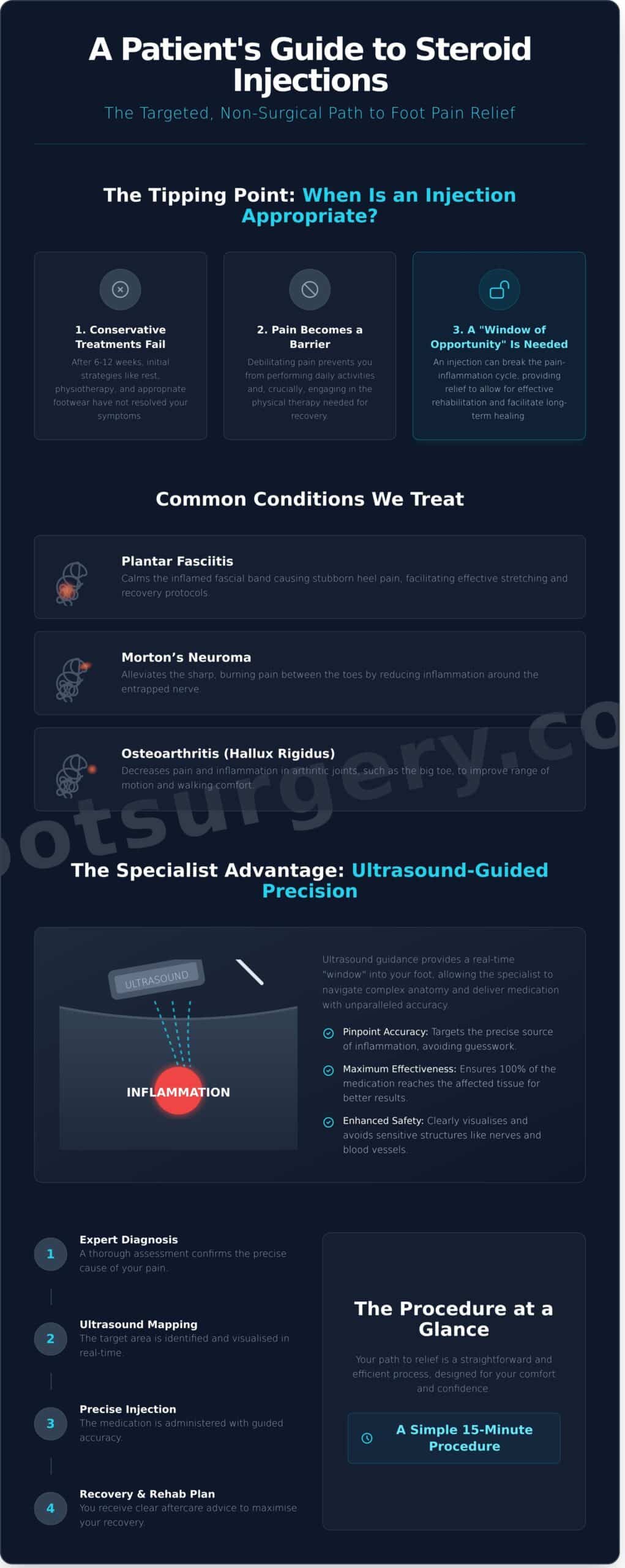
What to Expect: The Procedure and Recovery in Northallerton
Your steroid injection for foot pain will be carried out by Mr Refaie in a safe, clinical environment at one of his North Yorkshire locations, such as the Friarage Hospital in Northallerton or BMI Woodlands Hospital in Darlington.
The entire appointment is straightforward and typically takes around 15-20 minutes.
- Consultation & Consent: Mr Refaie will first discuss the procedure with you, confirm the diagnosis, and answer any final questions before you provide consent.
- Positioning & Cleaning: You will be asked to lie down comfortably. The skin on your foot will be thoroughly cleaned with an antiseptic solution.
- Guidance & Numbing: The X-ray machine will be positioned. Mr Refaie will use a local anaesthetic to numb your skin, which may cause a brief stinging sensation.
- The Injection: Using the X-ray image as a guide, the needle containing the steroid and more local anaesthetic is carefully advanced to the target. You may feel a sensation of pressure, but the procedure should not be painful.
- Completion: The needle is removed, and a small plaster is applied to the site.
The Day of the Injection
You do not need to fast before the procedure, but you should bring a list of your current medications. The local anaesthetic mixed with the steroid provides immediate pain relief, but it will wear off after a few hours. Because of this temporary numbness, it is advisable to arrange for someone to drive you home.
The First 48 Hours and Beyond
- The "Pain Window": As the local anaesthetic wears off and before the steroid takes full effect (which can take 3-7 days), you may experience a temporary increase in pain known as a "steroid flare." This is normal and can be managed with ice and simple painkillers.
- Rest is Vital: You must rest your foot as much as possible for the first 48 hours. This allows the medication to settle and begin working effectively. Avoid strenuous activity and prolonged standing.
- Monitoring: While rare, you should monitor for any signs of infection (increasing redness, swelling, heat) or side effects like skin thinning or depigmentation at the injection site.
You will typically start to feel the real benefits of the injection within the first week, with relief often lasting for several months.
Expert Foot Care with Mr Ramsay Refaie
Choosing to have a non-surgical treatment like a steroid injection performed by a Consultant Orthopaedic Surgeon provides significant benefits. Mr Refaie’s deep understanding of foot and ankle mechanics, gained over 15+ years, informs every aspect of your care. He uses injections not just to treat symptoms, but as part of a holistic strategy to restore function, informed by a complete understanding of all potential surgical and non-surgical pathways.
This approach aligns with his "minimally invasive" philosophy, which prioritises the most effective, least disruptive treatment to get you back on your feet. You can access his private care at leading hospitals across the region, including Tees Valley Hospital, Nuffield Health Tees, and BMI Woodlands.
A Patient-Centered Approach to Mobility
Mr Refaie’s goal is to move beyond simply masking pain and towards genuine functional restoration. He provides complete transparency in treatment plans and pricing for both self-pay and insured patients, ensuring you are fully informed and confident in your care.
Your Local North Yorkshire Clinic Locations
With convenient clinic locations, Mr Refaie provides expert care for patients across Darlington, Stockton, Northallerton, and the wider North Yorkshire area. The private patient facilities at hospitals like the Friarage offer a comfortable, efficient, and professional environment for your consultation and treatment.
Take the first step towards lasting foot pain relief.
Book your consultation with Mr Refaie today
Frequently Asked Questions
How long does a steroid injection for foot pain typically last?
The duration of relief varies depending on the individual and the condition being treated. Many patients experience relief for several months. For some, one injection is enough to break the inflammatory cycle and allow the body to heal, while others may need repeat injections to manage chronic conditions.
Is a steroid injection in the foot painful?
A local anaesthetic is used to numb the area, so the procedure itself should not be painful. You may feel a brief sting from the numbing injection and a sensation of pressure. It is common to experience some soreness or a "steroid flare" for 24-48 hours after the procedure as the anaesthetic wears off.
How many steroid injections can I have in my foot in one year?
To minimise the risk of side effects like tendon weakening or fat pad atrophy, it is generally recommended to have no more than three injections into the same site within a 12-month period. Mr Refaie will discuss the appropriate treatment frequency for your specific situation.
Can I drive home after receiving a steroid injection in my foot?
It is strongly recommended that you arrange for someone to drive you home. The local anaesthetic can cause temporary numbness in your foot, making it unsafe to operate a vehicle.
What are the risks of steroid injections for plantar fasciitis?
When performed with imaging guidance by a specialist, the risks are low. The most significant specific risk for plantar fasciitis is a rupture of the plantar fascia, though this is rare. Other general risks include infection, skin discolouration, and fat pad atrophy (thinning of the protective pad under the heel).
Will my private medical insurance (BUPA, AXA) cover the cost of the injection?
Most major private medical insurers cover diagnostic consultations and guided steroid injections for recognised medical conditions. However, policies vary, so it is essential to contact your provider beforehand to confirm your coverage and obtain an authorisation code.
How soon can I return to exercise after a foot injection?
You should rest your foot for the first 48 hours and avoid high-impact activities for at least one to two weeks. Mr Refaie will provide you with specific guidance based on your condition and the type of activities you wish to return to. A gradual return to exercise is always recommended.
What happens if the steroid injection doesn’t work?
If a well-placed, guided steroid injection does not provide relief, it gives valuable diagnostic information. It may indicate that the pain is coming from a different source, or that the condition is too advanced and may require a different treatment approach, such as surgery. Mr Refaie will discuss the next steps with you in a follow-up consultation.