Last Tuesday, a patient from Stockton-on-Tees explained the difficult decision to put her favourite walking shoes away for good. The constant pressure and pain from a developing claw toe had made even short walks an ordeal. It’s a familiar story for many: the daily compromise with footwear, the frustration when toe pads and splints fail to provide lasting relief, and the deep-seated anxiety about potential surgery. We understand these concerns because we address them for our patients every single day.
This guide is designed to provide the clarity and confidence you need to move forward. Here, Mr Ramsay Refaie Foot and Ankle Surgeon will detail how expert lesser toe deformity correction in Teesside can permanently realign hammer, claw, and mallet toes, eliminating pain and restoring your foot’s natural function. We’ll walk you through the modern, minimally invasive procedures that allow for a quicker, more comfortable recovery, and explain how you can be back to your active lifestyle, wearing the shoes you love, by 2026.
Key Takeaways
- Understand the key differences between hammer, claw, and mallet toes to identify which condition may be affecting your foot health and comfort.
- Discover how muscle and tendon imbalances lead to toe deformities, and why addressing this root cause is crucial for lasting pain relief.
- Explore the modern surgical techniques for lesser toe deformity correction Teesside, which focus on structural realignment rather than outdated procedures.
- Gain a clear overview of the patient journey, from your initial consultation and diagnosis through to your complete recovery plan with a specialist surgeon.
Understanding Lesser Toe Deformities: Why Your Toes Change Shape
Lesser toe deformities are structural changes affecting the second, third, fourth, or fifth toes, causing them to bend into unnatural positions such as a claw or hammer shape. Far from being a simple cosmetic issue, these conditions arise from a fundamental imbalance between the small muscles and tendons that control toe movement. When this delicate tension is disrupted, certain tendons pull with greater force than others, gradually forcing the toe joints out of alignment. This progressive process can lead to significant pain, difficulty with footwear, and a reduction in your quality of life.
To better understand the mechanics and solutions for these conditions, this video provides a helpful overview.
The underlying causes of this imbalance are varied and often interconnected. While genetics can predispose an individual to certain foot structures, external factors frequently trigger the progression of the deformity. The most common culprits include:
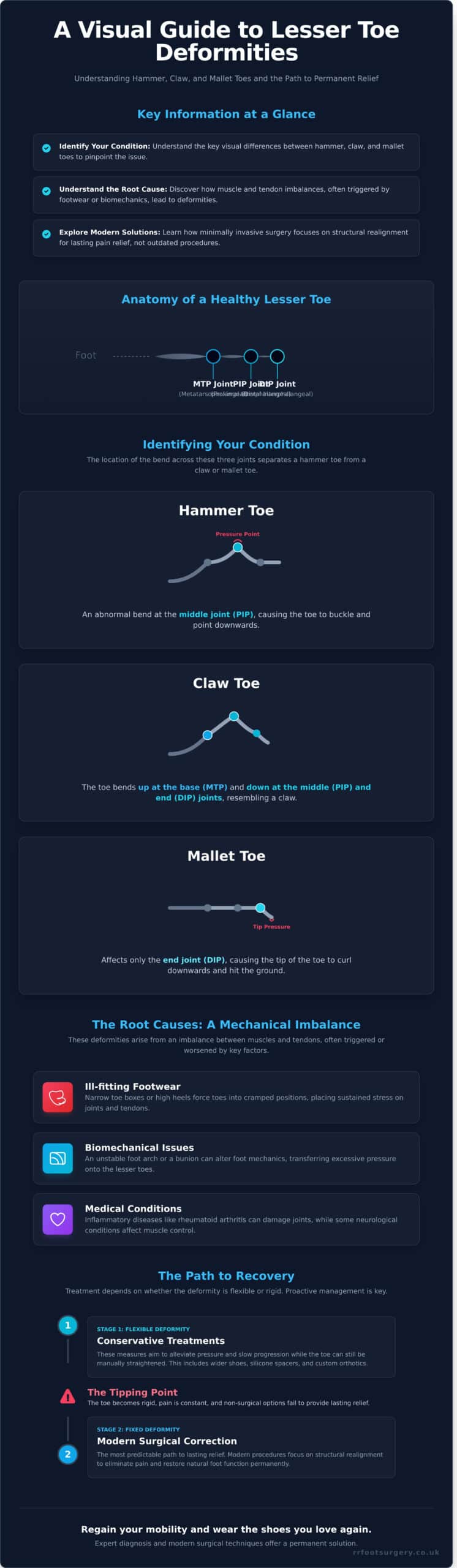
- Ill-fitting Footwear: Shoes with a narrow toe box or high heels force the toes into a cramped, bent position, placing sustained stress on the joints and tendons.
- Biomechanical Issues: An unstable foot arch or the presence of a bunion (hallux valgus) can alter foot mechanics, transferring excessive pressure onto the lesser toes.
- Medical Conditions: Inflammatory diseases like rheumatoid arthritis can damage the joints, while certain neurological conditions can affect muscle control in the feet.
Ignoring the early signs often leads to a “fixed” deformity, where the joint becomes rigid and cannot be manually straightened. This stage is typically more painful and complex to treat, underscoring the importance of early assessment. For a technical overview of the different classifications, you can find useful information by Understanding Hammer Toe and its related conditions. Waiting and seeing is rarely a successful strategy; proactive management is key.
The Impact of Footwear and Lifestyle in Teesside
Here in Teesside, our active lifestyles and work environments can play a direct role. From steel-toe capped boots required in local industries to the repetitive impact from running along the River Tees, specific footwear and activities can accelerate toe deformities. Furthermore, a very common scenario involves a developing bunion, which causes the big toe to drift inwards. This process effectively crowds out the second toe, often forcing it to buckle upwards and become a secondary problem requiring expert lesser toe deformity correction in Teesside.
When Conservative Treatments Are No Longer Enough
Initially, flexible deformities may respond to conservative measures like wider shoes, silicone toe spacers, or custom orthotics. These interventions can alleviate pressure and slow progression, but they cannot reverse an established structural change. The tipping point arrives when the toe becomes rigid, pain is constant, or corns and calluses develop from friction against footwear. At this stage, a lesser toe deformity is best defined as a progressive mechanical failure of the digital joints, and surgical intervention becomes the most predictable path to lasting relief and restored function.
Hammer, Claw, and Mallet Toes: Identifying Your Condition
Lesser toe deformities are often grouped together, but understanding the precise nature of your condition is the first critical step toward effective treatment. While they all involve an abnormal bend in one or more of the smaller toes, the specific joint affected determines the diagnosis. A clear identification is essential because the underlying causes and, consequently, the most appropriate surgical solutions can differ significantly.
To understand these deformities, it helps to know the basic anatomy of your toe. Each lesser toe has three small bones (phalanges) and three joints:
- Metatarsophalangeal (MTP) Joint: The “knuckle” joint, where the toe connects to the foot.
- Proximal Interphalangeal (PIP) Joint: The middle joint of the toe.
- Distal Interphalangeal (DIP) Joint: The end joint, nearest to the toenail.
The location of the bend across these three joints is what separates a hammer toe from a claw or mallet toe.
Hammer Toes, Claw Toes, and Mallet Toes: What is the Difference?
A precise diagnosis is fundamental to successful treatment. During a clinical assessment, we carefully evaluate which joints are affected to define the deformity. A hammer toe, for example, involves a flexion contracture (a downward bend) at the PIP joint, causing the middle of the toe to buckle upwards. This most commonly affects the second toe, particularly if it is longer than the great toe. In contrast, a claw toe deformity is more complex, involving hyperextension at the MTP joint and flexion at both the PIP and DIP joints. This gives the toe a “clawed” appearance and often affects all four lesser toes simultaneously. Mallet toe is the most localised of the three, with the bend occurring only at the DIP joint, making the tip of the toe press into the sole of your shoe.
Associated Complications: Corns and Metatarsalgia
The visible bend is only part of the story. The change in your toe’s alignment creates secondary problems that cause significant pain and discomfort. The most common issue is the formation of painful corns and calluses. When a hammer toe buckles, the top of the PIP joint becomes the highest point, rubbing constantly against your footwear. This pressure stimulates the skin to thicken for protection, forming a hard corn that can feel like a stone in your shoe. Similarly, the altered toe position changes how weight is distributed across the front of your foot. The toes may pull the protective fatty pad away from the ball of the foot, exposing the metatarsal heads to excessive pressure and causing a deep, burning pain known as metatarsalgia. Simply treating the corn provides only temporary relief; lasting comfort comes from addressing the bone’s position. This is the entire purpose of expert lesser toe deformity correction in Teesside.
Distinguishing between a flexible deformity, which can be manually straightened, and a rigid one is another vital diagnostic step. This assessment directly influences the treatment plan, a key aspect detailed in the British Orthopaedic Foot & Ankle Society’s guide to Lesser Toe Deformity management. A thorough clinical evaluation is the only way to determine the severity and nature of your condition. If you are struggling with persistent toe pain, an initial consultation can provide the diagnostic clarity needed to restore your comfort and mobility.
Surgical Options for Lesser Toe Deformity Correction
When conservative treatments no longer provide relief, surgery offers a definitive solution for painful lesser toe deformities. Modern podiatric surgery has evolved significantly beyond the simplistic “toe clipping” procedures of the past. Today, the focus is on a comprehensive biomechanical approach, aiming to correct the underlying structural imbalance rather than just addressing the cosmetic symptom. The goal is to restore a stable, functional, and pain-free foot.
The choice of procedure is meticulously tailored to your specific anatomy and the rigidity of the deformity. It’s not a one-size-fits-all solution. The primary surgical strategies include:
- Joint Remodelling (Arthroplasty): Often used for more flexible deformities, this technique involves removing a small portion of the bone at the affected joint. This creates space, allowing the toe to be repositioned into a straighter alignment without tension.
- Joint Fusion (Arthrodesis): For rigid, fixed deformities, fusing the joint is the most reliable method for permanent correction. The joint surfaces are removed, and the bones are held together with internal fixation, allowing them to heal into one solid, straight bone.
- Tendon Transfer or Lengthening: In some cases, the imbalance is caused by overly tight tendons pulling the toe out of position. A procedure to lengthen or re-route these tendons can release the deforming force and restore balance.
At our practice, Mr. Ramsay Refaie champions the use of minimally invasive techniques wherever clinically appropriate. This patient-first philosophy prioritises smaller incisions and less disruption to surrounding tissues, which often translates into a more comfortable and efficient recovery for those seeking lesser toe deformity correction in Teesside.
Minimally Invasive (Keyhole) vs. Open Surgery
Minimally invasive surgery (MIS) is performed through tiny incisions, often just 2-3mm long. This approach reduces scarring and soft tissue damage, which can lead to less post-operative swelling and a quicker return to comfortable footwear. However, for complex, severe, or revision cases, traditional open surgery remains the gold standard. It provides the direct visualisation needed to manage significant structural changes. Both approaches are highly effective and are almost always performed as day-case procedures, allowing you to recover in the comfort of your own home.
The Role of Digital Implants and Internal Fixation
The method used to hold the toe in its corrected position has been revolutionised. For decades, the standard was a temporary Kirschner-wire (K-wire) that protruded from the tip of the toe for 4-6 weeks. While effective, these external wires can be cumbersome and carry a risk of pin-site infection. Today, we have access to advanced intramedullary implants. These tiny, sophisticated devices are placed entirely inside the bone, providing robust, stable fixation without any external parts. This modern approach to lesser toe deformity correction Teesside eliminates the inconveniences of K-wires, significantly enhances patient comfort during recovery, and provides the stability needed to reduce the risk of recurrence. A deep understanding of joint mechanics, as explained in comprehensive guides like the Cleveland Clinic’s overview of Hammer Toe Causes and Treatment, underscores why this stable, anatomical fixation is critical for a lasting successful outcome.
The Patient Journey: Surgery and Recovery in Teesside
Understanding the path from consultation to full recovery is essential for feeling confident and prepared. Your journey is a structured partnership between you and our surgical team, designed to ensure the best possible outcome. It starts with a detailed pre-operative assessment at one of our Teesside locations, such as BMI Woodlands Hospital or Tees Valley Hospital, where we conduct a thorough evaluation and answer all your questions.
On the day of your surgery, the focus is entirely on your safety and comfort. Most lesser toe corrections are performed as day-case procedures, meaning you can return home the same day. You will have a final discussion with the anaesthetist to decide on the best option for you. Many patients opt for a local anaesthetic block with sedation, which numbs the foot completely while you remain relaxed and sleepy. A general anaesthetic, where you are fully asleep, is also available and is chosen based on patient preference and medical suitability.
The first 48 hours post-surgery are pivotal for a smooth recovery. Pain is managed with prescribed medication, but the single most effective action you can take is strict elevation. You must keep your foot elevated above the level of your heart for at least 50 minutes of every hour. This simple action is crucial for minimising swelling and discomfort. You will be fitted with a specialised post-operative shoe, often a “wedge shoe,” which is designed to offload pressure from the front of your foot, protecting the delicate surgical correction as it begins to heal.
Recovery Timeline: From Surgery to Normal Shoes
Your recovery from lesser toe deformity correction Teesside follows a predictable, phased timeline. Adherence to this schedule is key to achieving optimal results.
- Weeks 1-2: The initial phase focuses on rest and wound healing. Your foot will remain in its surgical dressing. You will have a follow-up appointment at around two weeks, where Mr. Ramsay Refaie will inspect the wound, remove any sutures, and apply a fresh dressing. Weight-bearing is limited to essential movement around the house, always using the provided surgical shoe.
- Weeks 4-6: This period marks a significant transition. An X-ray is typically taken around the six-week mark to confirm the bone is healing correctly. Once satisfactory healing is observed, you can begin to transition out of the surgical shoe and into a supportive, wide-fitting trainer. Gentle mobilisation exercises can begin to restore your foot’s range of motion.
- Months 3-6: While you’ll be walking comfortably much earlier, the final traces of swelling can take between three and six months to fully resolve. During this time, you can gradually reintroduce more demanding activities. Most patients are cleared to return to high-impact sports and select their preferred footwear after the three-month mark, once healing is complete.
Local Aftercare and Physiotherapy in Teesside
Your rehabilitation is supported by a network of local healthcare professionals. We facilitate referrals to specialist foot and ankle physiotherapy services across Teesside, including clinics in Darlington and Middlesbrough, to help you regain strength and mobility. Consistent follow-up appointments with Mr. Ramsay Refaie are scheduled to monitor bone healing and ensure your recovery stays on track. Most patients find they can return to driving between 4 and 6 weeks after surgery, depending on which foot was operated on and the type of vehicle they drive. To discuss the specifics of your own surgical plan and recovery, schedule your personal consultation today.
Expert Lesser Toe Correction with Mr Ramsay Refaie
Choosing the right specialist is the single most critical decision you’ll make on your journey to correcting a painful toe deformity. While a general practitioner can provide an initial diagnosis, the intricate biomechanics of the foot demand the expertise of a Consultant Orthopaedic Surgeon who specialises exclusively in foot and ankle conditions. Mr Ramsay Refaie brings this dedicated focus to every patient, combining years of advanced surgical training with a meticulous, patient-centred approach designed to restore not just function, but your quality of life.
Opting for private care with Mr Refaie provides two immediate and significant advantages: speed and direct access. You can bypass long NHS waiting lists, which often exceed 18 weeks for elective procedures, and secure a consultation promptly. From your first appointment to your final post-operative review, you will see Mr Refaie personally. This continuity of care is fundamental to his practice. It ensures a deep understanding of your specific condition, your lifestyle goals, and your recovery progress, fostering a relationship built on trust and clear communication. His entire philosophy is centred on providing expert lesser toe deformity correction in Teesside that is as efficient as it is effective.
Convenient Consultation Locations Across the Tees Valley
To ensure accessibility for patients throughout the region, Mr Refaie offers consultations at several of the area’s leading private and NHS hospitals. This network allows you to choose a location that best suits you, with flexible appointment times designed to accommodate professional and personal commitments. Locations include:
- BMI Woodlands Hospital in Darlington
- Nuffield Health Tees Hospital in Stockton-on-Tees
- Tees Valley Hospital in Middlesbrough
- The Friarage Hospital in Northallerton
Taking the Next Step Toward Pain-Free Walking
Your journey back to comfort begins with a simple step. We welcome both self-pay patients and those with private medical insurance from major providers including Bupa, AXA, and Aviva. Your initial consultation is a vital diagnostic meeting. Mr Refaie will conduct a thorough physical examination, discuss your symptoms and medical history, and may arrange for imaging like X-rays to gain a precise understanding of the deformity. This detailed assessment is the foundation for a successful, tailored treatment plan.
Don’t let foot pain dictate how you live your life. Restoring your mobility and comfort is possible with a clear, expert-led plan. If you are seeking a definitive solution for your lesser toe deformity, we invite you to take the first step. Book your consultation with Mr Ramsay Refaie today and begin your path to walking without pain.
Take the Next Step Towards Pain-Free Mobility
Living with the daily discomfort of hammer, claw, or mallet toes doesn’t have to be your permanent reality. These conditions have clear causes, and modern surgical techniques offer precise, lasting relief. A specialist diagnosis is the crucial first step toward a treatment plan designed for your unique anatomy and lifestyle goals.
If you’re ready to explore lesser toe deformity correction Teesside, you are in expert hands. With over 15 years of specialist orthopaedic experience, Mr Ramsay Refaie provides consultant-led care at Teesside’s premier private hospitals, focusing on minimally invasive techniques to optimise your recovery. Taking control of your foot health begins with a professional assessment to understand your options.
It’s time to restore your comfort and reclaim the activities you love. Schedule Your Specialist Consultation with Mr Ramsay Refaie today and walk towards a more comfortable, active future.
Frequently Asked Questions About Lesser Toe Surgery
How long is the waiting list for private lesser toe surgery in Teesside?
The waiting list for private lesser toe surgery is typically between 2 and 4 weeks from your initial consultation. This short timeframe allows for necessary pre-operative assessments and scheduling at your convenience. We prioritise an efficient service to ensure you receive expert treatment and can begin your recovery without unnecessary delay. Our patient coordinator will provide precise dates once your surgical plan is confirmed, helping you to plan accordingly.
Will I need to stay in the hospital overnight after toe correction?
No, you won’t need to stay in the hospital overnight. Lesser toe deformity correction is performed as a day-case procedure, which means you will be admitted and discharged on the very same day. You can recover in the comfort of your own home. We provide comprehensive post-operative instructions and dedicated support to ensure your recovery at home is safe, comfortable, and successful from the very beginning.
Can I have multiple toes corrected at the same time?
Yes, it’s both possible and common to have multiple toes corrected during a single operation. Addressing all deformities simultaneously is often the most effective and convenient approach for patients. This strategy allows for a single surgical event and one consolidated recovery period. During your consultation, Mr. Refaie will assess your condition and discuss the optimal surgical plan to achieve the best functional and aesthetic result for your foot.
Is hammer toe surgery covered by private medical insurance like Bupa?
Yes, hammer toe surgery is typically covered by major private medical insurers, including Bupa, AXA, and Aviva. However, the level of coverage depends on the specifics of your individual policy. You will need to obtain a pre-authorisation code from your insurer before your treatment. Our administrative team is experienced in this process and can provide the necessary procedure codes to help you confirm your coverage with your provider.
When can I return to work after lesser toe deformity correction?
Your return to work depends entirely on your job’s physical demands. If you have a desk-based role, you can typically return within 2 to 3 weeks, provided you can keep your foot elevated. For more physically active jobs requiring prolonged standing or walking, you should plan for 6 to 8 weeks off work. A successful return to your daily life after your lesser toe deformity correction Teesside procedure is a key part of our planning.
Will my toe deformity return after surgical correction?
Recurrence is uncommon following modern surgical correction, with a success rate exceeding 95%. The advanced techniques Mr. Refaie employs are designed to provide a permanent solution by addressing the underlying structural cause of the deformity. Following post-operative advice, particularly regarding appropriate footwear choices, is crucial to minimise any risk of future problems. We are committed to achieving a lasting, positive outcome and restoring your foot’s natural function.
What are the risks associated with hammer toe surgery?
All surgical procedures have associated risks, though they are low for hammer toe surgery. The primary risks include infection, prolonged swelling, stiffness in the toe joint, or temporary nerve irritation. Less common risks are blood clots (DVT) or delayed bone healing. Mr. Refaie will discuss these potential complications in detail during your consultation, ensuring you can make a fully informed decision about your care and the measures we take to minimise every risk.
Do I need a GP referral to see Mr Ramsay Refaie for a private consultation?
No, a GP referral is not required if you are self-funding your treatment. You can contact our clinic directly to schedule your private consultation. However, if you intend to use private medical insurance to cover your treatment, your provider will almost certainly require a formal referral letter from your GP. Our team can advise you on the correct pathway for your specific circumstances to ensure a smooth process.