The persistent discomfort of a toe rubbing against your shoe, the frustration of struggling to find comfortable footwear, and the quiet self-consciousness about the appearance of your feet-these are challenges we understand intimately. For many, these are the daily realities of living with conditions like hammer, claw, or mallet toe, and the concern that the problem may be worsening is a valid one. Fortunately, lasting relief is not only possible but is the primary goal of effective lesser toe deformity correction.
This comprehensive patient guide is designed to demystify the entire process, providing you with a clear and reassuring path forward. We will methodically explore the causes of these common podiatric conditions and detail the modern, often minimally invasive, surgical solutions available to restore both comfort and confidence. From your initial consultation through to a detailed, step-by-step recovery timeline, our aim is to provide the clarity you need to make an informed decision. The journey towards walking without pain and wearing your favourite shoes again begins with understanding your options.
Key Takeaways
- A precise clinical diagnosis is the essential first step, ensuring your treatment plan is perfectly tailored to your specific condition and lifestyle goals.
- Successful lesser toe deformity correction is not one-size-fits-all; understand the differences between traditional and advanced minimally invasive surgical options.
- Demystify the post-operative period with a realistic week-by-week timeline, helping you to confidently plan for your recovery and return to activity.
- Learn to identify the distinct characteristics of hammer, claw, and mallet toes to better understand your symptoms and facilitate a more productive consultation.
Understanding Lesser Toe Deformities: Hammer, Claw & Mallet Toes
We understand that living with a toe deformity can be a source of daily frustration and pain. The simple act of putting on shoes can become a painful ordeal, and the appearance of your feet may cause you to feel self-conscious. If you are experiencing discomfort from a toe that is bent, buckled, or curling downwards, you are not alone. These conditions are common and treatable.
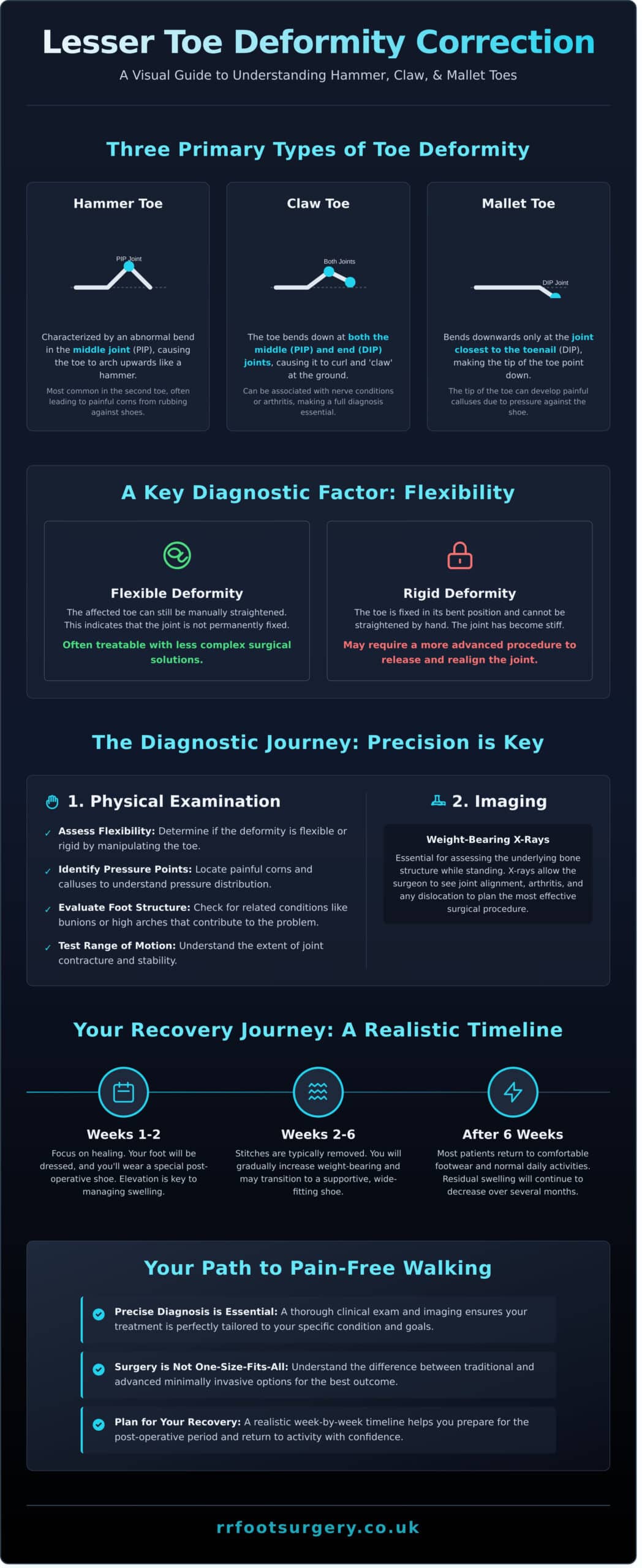
The term ‘lesser toe’ refers to any toe except the big toe. When these smaller toes develop a bend at one or more of their joints, it is known as a lesser toe deformity. There are three primary types, each defined by which joint is affected. A foundational overview of Hammer, Claw & Mallet Toes can be helpful, but a clinical diagnosis is essential for proper treatment. The core cause is often an imbalance in the muscles and tendons that hold the toe straight, which can be aggravated by factors like ill-fitting footwear, an injury, or the presence of a bunion on the big toe.
A crucial factor in your diagnosis is whether the deformity is ‘flexible’ or ‘rigid’. A flexible deformity means the toe can still be manually straightened, while a rigid deformity is fixed in its bent position. This distinction is vital, as it directly influences which options for lesser toe deformity correction will be most effective for restoring comfort and function.
What is a Hammer Toe?
A hammer toe is characterised by an abnormal bend in the middle joint of the toe, known as the proximal interphalangeal (PIP) joint. This causes the middle of the toe to arch upwards, resembling the shape of a hammer. It most frequently affects the second toe, particularly when a bunion causes the big toe to drift inwards and crowd the smaller toes. This raised joint often rubs against the inside of footwear, leading to painful corns and calluses.
What are Claw and Mallet Toes?
Claw and mallet toes are similar but affect different joints. A claw toe bends down at both the middle (PIP) and end (DIP) joints, making the toe curl under and ‘claw’ at the ground. A mallet toe, by contrast, only bends downwards at the joint closest to the toenail (the DIP joint). While footwear can contribute, these conditions are sometimes associated with underlying medical issues such as arthritis, nerve damage, or diabetes, making a thorough consultation essential for proper care.
The Crucial First Step: How a Surgeon Diagnoses Your Deformity
A successful, long-term outcome for any foot surgery begins not in the operating theatre, but in the consultation room. A precise diagnosis is the foundation upon which your entire plan for lesser toe deformity correction is built. Our primary goal is to address the underlying structural cause of your hammer or claw toe, rather than just treating the painful symptoms like corns. The process of understanding how a surgeon diagnoses your deformity involves a meticulous combination of a hands-on clinical assessment and diagnostic imaging.
The Physical Examination
During your consultation, a thorough physical examination of your foot and ankle provides critical information. A key diagnostic step is determining whether the deformity is flexible or rigid. By gently manipulating the affected toe, your surgeon can assess if the joint can still be straightened manually. This simple test is fundamental, as a flexible toe often requires a less complex surgical solution than a rigid, fixed one. The examination also includes:
- Assessing Stability and Motion: We evaluate the range of motion in the toe joints to understand the extent of the contracture.
- Identifying Pressure Points: We locate painful areas, corns, and calluses, which indicate where abnormal pressure is being applied during walking.
- Evaluating Overall Foot Structure: A lesser toe deformity rarely exists in isolation. We will check for associated conditions like a bunion (Hallux Valgus) or a high arch, which may be contributing to the problem.
The Importance of Imaging
While the physical exam reveals much about the soft tissues and joint flexibility, weight-bearing X-rays are essential for assessing the underlying bone structure. These images are taken while you are standing, allowing the surgeon to see how your bones align under the natural load of your body. On an X-ray, we can precisely identify joint subluxation (partial dislocation), the presence of arthritis, and the exact angles of the bones.
This detailed view is fundamental to planning the most effective surgical procedure for your specific anatomy. It allows for precise surgical planning, ensuring the chosen technique will deliver lasting relief and a stable, functional result. Please be reassured that obtaining X-rays is a quick, painless, and standard part of the diagnostic journey towards restoring your comfort and mobility.
Surgical Correction Techniques Explained: From Open to Minimally Invasive
When non-surgical treatments no longer provide relief, surgical intervention becomes the most effective path toward lasting comfort and mobility. It is important to understand that there is no single, ‘one-size-fits-all’ operation for hammer or claw toes. Your procedure will be meticulously tailored to your specific anatomy, the severity of the deformity, and your personal lifestyle goals. The fundamental aim of any lesser toe deformity correction is to realign the toe into a straight, functional position, thereby relieving the painful pressure on the joints and skin.
Often, a combination of techniques is employed to achieve the most stable and durable outcome. These procedures are typically performed as a day-case, meaning you can return home the same day, and can be conducted under either a local or general anaesthetic, depending on the complexity of the correction and your personal preference.
This focus on tailored, modern surgical solutions is a hallmark of many specialist medical fields. For example, patients seeking treatment for abdominal wall issues might look to a dedicated centre like the Brisbane Hernia Clinic, which similarly provides a range of advanced surgical options for their specific condition.
Tendon Releases and Transfers
For early-stage deformities where the toe joint is still flexible, the issue often lies with an imbalance in the soft tissues. A tendon release or transfer is a less invasive procedure designed to lengthen or reroute the tight tendons that are pulling the toe out of its natural alignment. By addressing this muscular pull, the toe can relax back into a straighter position, alleviating pain and preventing the deformity from becoming rigid.
Arthroplasty and Arthrodesis (Joint Reshaping & Fusion)
When a toe deformity has become rigid and fixed, a soft-tissue procedure alone is insufficient. In these cases, we must address the joint itself. There are two primary techniques for this:
- Arthroplasty: This involves removing a small portion of the bone from the joint, which creates space and allows the toe to be straightened.
- Arthrodesis (Fusion): In this procedure, the joint surfaces are removed, and the two bones are fused together in a corrected, straight position. This provides permanent stability.
Both arthroplasty and arthrodesis are highly effective for severe deformities. To hold the toe in its new position while it heals, we may use a small internal screw or a temporary pin (known as a K-wire) that is removed in the clinic after a few weeks. As detailed by leading medical institutions, these Surgical Correction Techniques Explained are the gold standard for restoring toe function and relieving pain associated with rigid contractures.
Minimally Invasive Surgery (MIS)
A modern advancement in lesser toe deformity correction is the use of minimally invasive surgery. This highly specialised technique involves making tiny, ‘keyhole’ incisions (typically just 2-3mm) through which fine surgical instruments are passed. These instruments are used to cut and realign the bone (a procedure known as an osteotomy) without the need for large openings. The potential benefits include significantly less post-operative swelling, minimal scarring, and a potentially quicker recovery period for suitable candidates.
Your Recovery Journey: A Realistic Week-by-Week Timeline
One of the most common concerns for patients considering surgery is the recovery period. The prospect of a long or difficult healing process can be daunting. However, a successful recovery from lesser toe deformity correction is not about enduring a lengthy ordeal, but about following a structured, manageable plan. Your commitment to these post-operative instructions is the single most important factor in achieving an excellent, long-lasting result.
This timeline provides a clear, realistic guide to what you can expect as you heal. While every individual’s journey is unique, this framework will help you prepare for a smooth and predictable return to your daily life.
The First 2 Weeks: Rest and Elevation
Immediately following your procedure, you will be able to walk short distances in a special post-operative surgical shoe. The primary focus during this initial phase is managing swelling. This is achieved through strict elevation of the foot above the level of your heart whenever you are resting. Pain is typically well-managed with prescribed medication. It is vital to keep your dressings clean and dry to protect the surgical site and promote healing.
Weeks 2 to 6: Gradual Return to Activity
Your first follow-up appointment usually occurs around the two-week mark, where any stitches or temporary K-wires may be removed. At this stage, you can often transition from the surgical shoe to a wide, supportive shoe, such as a comfortable trainer. We may introduce gentle mobilisation exercises to restore flexibility. You can typically consider returning to driving once you can perform an emergency stop without pain, but it is essential to confirm this with your car insurance provider first.
Beyond 6 Weeks: Returning to Normality
While you will be significantly more mobile, some residual swelling is normal and can persist for several months, gradually subsiding over time. Most patients can return to more strenuous activities, such as running and sports, from around three months post-surgery. To protect the outcome of your lesser toe deformity correction and prevent recurrence, we will provide guidance on appropriate long-term footwear that offers adequate support and space for your toes.
For a personalised assessment of your condition and recovery expectations, please feel free to schedule a consultation.
Your Consultation with Mr. Refaie: The Path to Pain-Free Walking
Embarking on the journey to resolve foot pain begins with a comprehensive and compassionate consultation. At Mr Ramsay Refaie Foot and Ankle Surgeon, our approach is fundamentally patient-centred; it starts not with a procedure, but with a person. Mr Refaie’s thorough diagnostic process is the cornerstone of his practice, ensuring that any treatment plan is precisely tailored to your unique clinical needs, lifestyle, and personal goals. This initial meeting is your opportunity to understand the root cause of your discomfort and explore the full spectrum of solutions designed to restore your comfort and mobility.
With extensive expertise in both traditional and advanced surgical techniques, Mr Refaie is a specialist in providing bespoke treatment. His proficiency in state-of-the-art Minimally Invasive Surgery (MIS) often allows for smaller incisions, reduced post-operative pain, and a quicker return to daily activities. This commitment to modern, evidence-based methods ensures you receive the most effective and least disruptive path to recovery for your lesser toe deformity.
A Personalised Surgical Plan
During your initial appointment at one of our clinics in Tees Valley or North Yorkshire, Mr Refaie will conduct a detailed clinical assessment, discussing how your symptoms impact your daily life. He will then present all appropriate non-surgical and surgical options, clearly explaining the benefits and considerations of each. If surgery is the recommended course of action, he will articulate the precise rationale for the proposed technique, ensuring you understand why it is the optimal choice for your specific lesser toe deformity correction. You will have dedicated time to ask questions, ensuring you can make a calm, confident, and fully informed decision about your care.
Booking Your Appointment
We aim to make the process of scheduling your consultation as straightforward and accessible as possible. We offer transparent self-pay packages and are recognised by all major private medical insurance providers. To arrange your initial meeting with Mr Refaie and begin your journey towards relief, please follow the simple steps below.
- Contact: Please get in touch with Mr Refaie’s private secretary, who will be happy to assist you with available dates and answer any preliminary questions.
- Locations: Consultations are conveniently held at our modern clinic locations in Darlington, Middlesbrough, and across North Yorkshire.
- Insurance: If you are using private medical insurance, please have your policy details and authorisation code available when you book to ensure a seamless process.
Don’t let foot pain dictate your life any longer. Book your consultation today and take the first step towards resolving your foot pain.
Your Next Step Towards Pain-Free Mobility
Living with the daily discomfort of a hammer, claw, or mallet toe is a challenge, but it is one you do not have to face alone. As we have explored, understanding your diagnosis and the advanced surgical options available is the first step towards lasting relief. A successful lesser toe deformity correction, guided by an expert and followed by a structured recovery, can restore your comfort and return you to the activities you love.
If you are ready to reclaim your active lifestyle, we invite you to take the next step. Mr. Refaie, a Consultant Orthopaedic Surgeon with over 15 years of specialist experience, provides dedicated care at clinics across Darlington, Middlesbrough, and North Yorkshire. He is committed to developing a personalised treatment plan that empowers you to move forward with confidence.
Schedule a consultation with Mr. Refaie to discuss your treatment options. Your journey back to pain-free walking and an improved quality of life is within reach.
Frequently Asked Questions About Lesser Toe Deformity Correction
Is lesser toe deformity correction surgery very painful?
Modern surgical techniques are designed to minimise discomfort. The procedure is typically performed under a local anaesthetic block, meaning your foot will be numb. After your lesser toe deformity correction, some post-operative pain is normal as the anaesthetic wears off, but this is well-managed with a prescribed course of pain relief medication. Our minimally invasive approach also helps to reduce swelling and pain, allowing for a more comfortable recovery experience.
Can a hammer toe or claw toe come back after surgery?
Recurrence of a hammer or claw toe is uncommon when the correct surgical procedure is performed and post-operative instructions are followed carefully. The goal of surgery is to create a permanent structural correction. However, factors such as continuing to wear ill-fitting footwear or underlying medical conditions can influence long-term results. We ensure patients are fully informed on how to protect their surgical outcome for lasting relief and mobility.
How long will I need to be off work after the operation?
The required time off work depends entirely on your role and the nature of your recovery. Patients with desk-based jobs who can elevate their foot may be able to return within two weeks. If your job involves prolonged standing, walking, or manual labour, you may require four to six weeks to recover sufficiently. We will provide personalised advice during your consultation to help you plan accordingly for a smooth and effective recovery.
What kind of shoes can I wear after lesser toe surgery?
Immediately following the procedure, you will wear a special post-operative surgical shoe for approximately two to four weeks to protect the toe as it heals. After this period, you can transition to a supportive, wide-fitting trainer. It is crucial to avoid narrow, pointed, or high-heeled shoes for at least three months to prevent pressure on the corrected toe and ensure the best possible long-term result. Your comfort and foot health remain our priority.
When can I start driving again after my foot operation?
You must not drive while wearing the post-operative surgical shoe. Typically, if the operation was on your left foot and you drive an automatic car, you may resume driving after two weeks. For a manual car, or if the surgery was on your right foot, you should wait until you can comfortably perform an emergency stop, which is usually around four to six weeks. It is essential to also check with your car insurance provider before driving.
Will I have a visible scar after the surgery?
Any surgical incision will result in a scar, but we take great care to ensure it is as discreet as possible. By utilising minimally invasive techniques, the incisions required are very small-often just a few millimetres long. These are strategically placed to be less noticeable. Over time, the fine scar line will fade significantly, blending with the surrounding skin and becoming difficult to see for most patients.
Are there any non-surgical options to fix a bent toe?
Non-surgical methods can effectively manage the symptoms of a hammer or claw toe but cannot correct the underlying structural deformity. Options such as wearing shoes with a wider toe box, using custom orthotic insoles, or applying protective padding can alleviate pain and prevent corns. While these measures provide relief for flexible, early-stage deformities, surgical intervention is the only definitive way to physically straighten the toe for a permanent solution.
How much does private lesser toe correction surgery cost in the UK?
The cost of private surgery varies based on the complexity of the procedure and the number of toes requiring correction. As a guide, the price for a single lesser toe correction in the UK typically ranges from £3,500 to £5,000. This is usually an all-inclusive package price that covers the surgeon’s fees, hospital costs, anaesthetist fees, and your post-operative follow-up appointments. A precise, transparent quotation will be provided following your initial consultation.