Does the simple thought of a walk through the Yorkshire Dales or tending to your garden bring a familiar, sharp reminder of ankle pain? For many, the persistent discomfort of ankle arthritis doesn’t just limit mobility; it gradually erodes the freedom to enjoy life in our beautiful region. That fear of losing your independence, of seeing the landscape as a series of obstacles rather than opportunities, is a heavy burden to carry.
This guide is designed to show you a clear path forward. Here, we will explore how a total ankle replacement in North Yorkshire, under the specialist care of Mr Ramsay Refaie, can provide lasting relief and restore the active lifestyle you thought was lost. We’ll demystify the surgical journey, from your initial consultation in Darlington or Northallerton to the final, confident steps of your recovery, so you can make an informed decision about your future mobility.
Key Takeaways
- Discover how replacing a damaged ankle joint can resolve the severe, chronic pain caused by end-stage arthritis and restore your quality of life.
- Understand the critical differences between total ankle replacement and ankle fusion, helping you evaluate which procedure best aligns with your mobility goals.
- Explore the modern surgical process, which uses 3D pre-operative planning and minimally invasive techniques to ensure precision and aid recovery.
- Learn about the structured rehabilitation pathway and how to access specialist consultations for a total ankle replacement North Yorkshire.
What is Total Ankle Replacement (TAR) and is it right for you?
Living with chronic ankle pain can fundamentally alter your life, turning simple pleasures like a walk through the North Yorkshire countryside into a daunting task. When end-stage osteoarthritis or rheumatoid arthritis erodes the protective cartilage in your ankle, the resulting bone-on-bone friction causes persistent pain, stiffness, and swelling. Total Ankle Replacement, or ankle arthroplasty, is a highly effective surgical procedure designed to resolve this. It involves precisely removing the damaged joint surfaces and replacing them with a state-of-the-art prosthetic implant, restoring smooth, pain-free movement.
To better understand the mechanics and benefits of this procedure, Mr Refaie recommends this informative overview:
For many years, ankle fusion (arthrodesis) was the standard surgical treatment for severe ankle arthritis. While effective for pain relief, fusion permanently locks the joint, significantly limiting mobility. Modern orthopaedics has seen a decisive shift. With significant advancements in implant technology and surgical techniques, TAR is now a superior alternative for many patients, preserving the crucial up-and-down motion of the ankle. This preservation of movement is key to a more natural gait and helps protect adjacent joints in the foot from developing secondary arthritis. It’s the reason a total ankle replacement in North Yorkshire is now a leading choice for restoring an active lifestyle.
The decision to proceed with surgery is made when you reach a ‘tipping point’. This is the stage where conservative treatments, such as physiotherapy, custom orthotics, or steroid injections, no longer provide adequate pain relief or functional improvement. If your daily activities are severely limited and your quality of life is compromised by ankle pain, it’s time to explore a definitive solution.
Understanding Ankle Arthritis Symptoms
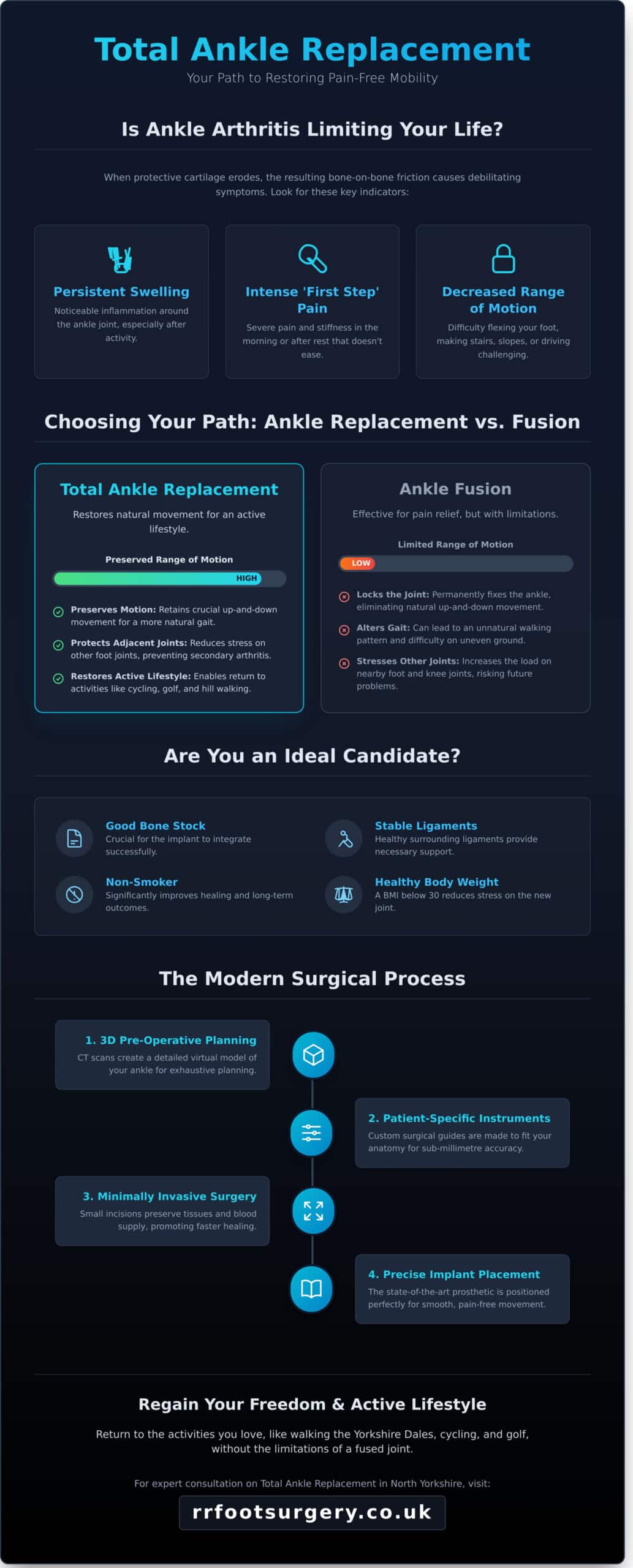
The signs of advanced ankle arthritis are often unmistakable and progressively worsen. Key indicators that you may be approaching the need for surgical intervention include:
- Persistent swelling: Noticeable puffiness and inflammation around the ankle joint, especially after activity like walking on the uneven terrain common to our local paths and coastlines.
- Intense ‘first step’ pain: Severe pain and stiffness when you first get out of bed in the morning or after a period of rest, which doesn’t ease as you get moving.
- Decreased range of motion: A growing difficulty in flexing your foot up or down, making it challenging to navigate stairs, slopes, or even drive a car.
Who is the Ideal Candidate for Ankle Arthroplasty?
A thorough consultation with Mr Refaie is essential to determine if you are a suitable candidate for TAR. While each patient’s case is unique, ideal candidates generally share several characteristics. Good bone stock around the ankle is crucial for the implant to integrate successfully, as are stable and healthy surrounding ligaments. To gain a deeper clinical understanding of what is ankle replacement surgery, it helps to recognise that patient selection is paramount for long-term success. Factors like a commitment to non-smoking and maintaining a healthy body weight (typically a BMI below 30) significantly improve outcomes and implant longevity by reducing stress on the new joint. This procedure is increasingly popular among the ‘active elderly’ in the Tees Valley and beyond, as it allows them to return to activities like golf, cycling, and hill walking without the limitations of a fused joint.
The Surgical Procedure: Precision and Modern Technology
A total ankle replacement is far more than a simple operation; it’s a meticulously planned synthesis of surgical skill and advanced bio-engineering. At the heart of Mr Ramsay Refaie’s approach is a commitment to precision, beginning long before you enter the operating theatre. Using state-of-the-art 3D CT scans, a detailed virtual model of your ankle is created. This allows for exhaustive pre-operative planning and the creation of Patient-Specific Instrumentation (PSI), which are custom surgical guides designed to fit your unique anatomy perfectly.
This bespoke planning ensures that every bone cut is exact and the implant is positioned with sub-millimetre accuracy. Mr Refaie prioritises minimally invasive techniques, making incisions that are as small as possible to preserve the delicate soft tissues and blood supply surrounding the joint. This focus on tissue preservation is not just a technical detail; it is fundamental to promoting faster healing, reducing post-operative pain, and optimising your recovery journey.
The implant itself is a modern marvel. It typically consists of two primary metal components made from a durable cobalt-chrome alloy, which replace the damaged surfaces of the tibia and talus bones. Between them sits a medical-grade plastic bearing (ultra-high-molecular-weight polyethylene) that acts like natural cartilage, facilitating a smooth, gliding motion. This three-part system is engineered to replicate the natural movement of a healthy ankle, restoring function and relieving pain.
The Step-by-Step Surgical Journey
On the day of your surgery at one of North Yorkshire’s leading private hospitals, the focus is on your safety and comfort. Anaesthesia is tailored to you, often involving a regional nerve block that numbs the leg, supplemented by sedation or a general anaesthetic. Once prepared, Mr Refaie makes a precise incision at the front of the ankle. The damaged bone and cartilage are carefully removed, and the bone is prepared to accept the prosthesis. The final alignment is critical; ensuring the ankle is perfectly ‘balanced’ is just as important as the implant itself for long-term success and a natural gait. For a detailed patient-level overview, the NHS provides excellent resources on the Total Ankle Replacement procedure, noting that 85-90% of modern implants function well after 10 years.
Advanced Implant Technology
Implant technology has evolved significantly. Early designs often relied on bone cement for fixation, but modern prostheses predominantly use ‘uncemented’ biological fixation. The metal components have a specialised porous coating that encourages your own bone to grow into the implant over several weeks, creating a strong, lasting biological bond. Many contemporary designs are also ‘mobile-bearing’, allowing the plastic insert to move slightly. This helps to distribute forces more evenly across the joint, potentially reducing wear and tear over the long term. Throughout every total ankle replacement in North Yorkshire, stringent safety protocols in the operating theatre are followed to minimise the risk of infection and ensure the best possible outcome.
Understanding these technical aspects helps build confidence in the procedure. To learn how this modern approach could be tailored to your specific condition and restore your mobility, a personal consultation with Mr Refaie is the definitive next step.
Total Ankle Replacement vs. Ankle Fusion: Making the Choice
One of the first and most significant questions patients ask when facing debilitating ankle arthritis is, “Should I have my ankle fused or replaced?” It’s a valid and crucial query. For decades, ankle fusion (arthrodesis) was the only reliable surgical solution. Today, advanced technology and surgical techniques mean that for many, a total ankle replacement is an outstanding alternative that preserves motion. The right choice isn’t universal; it’s a deeply personal decision based on your anatomy, your lifestyle, and your future goals.
The fundamental difference lies in mechanics. Ankle fusion permanently joins the tibia and talus bones, creating a single, immobile unit. This provides exceptional, rock-solid stability and powerful pain relief but sacrifices the up-and-down movement of the joint. A total ankle replacement, however, uses prosthetic components to resurface the joint, aiming to replicate its natural, fluid motion. This preserves a more normal walking pattern, or gait. The decision must be tailored to your specific life, whether that involves walking the hills near Northallerton or simply enjoying daily activities in Darlington without pain.
A common concern revolves around longevity. Early ankle implants from over 20 years ago had inconsistent results, creating a lasting myth that they don’t last. Modern implants, however, are a world apart. Contemporary studies published in journals like The Bone & Joint Journal show that modern total ankle replacements have a survivorship rate of over 90% at 10 years. This durability has transformed the conversation, making a total ankle replacement in North Yorkshire a viable and often preferred long-term solution.
Ankle Fusion (Arthrodesis): Pros and Cons
Ankle fusion remains the ‘gold standard’ for certain patients. It is an excellent and highly predictable operation for individuals in high-impact professions, those with severe ankle deformity or bone loss, or younger patients with extremely high physical demands. The primary benefit is its durability; once the bones have fused, the result is permanent and robust. The trade-off, however, is the increased mechanical stress placed on the adjacent joints in the foot. Over a period of 10 to 15 years, this can lead to secondary arthritis in those joints. The recovery also differs, often requiring a longer period of non-weight-bearing (up to 12 weeks) to ensure the bones heal correctly.
Total Ankle Replacement: Pros and Cons
The greatest advantage of a total ankle replacement is the preservation of a natural walking pattern. By maintaining ankle motion, the procedure protects the surrounding joints from the accelerated wear and tear associated with fusion. This has a profound impact on daily life. Activities like climbing stairs, driving a car, and walking the dog become significantly more fluid and comfortable. It allows for a return to low-impact exercises such as cycling, swimming, and golf. The main consideration is that, like any artificial joint, it may eventually wear out and require an update, known as a revision surgery. For most patients, this is a future possibility that is far outweighed by the immediate and lasting benefits of restored mobility.
Ultimately, choosing between these two effective procedures requires a detailed consultation. With Mr. Refaie, every aspect of your health, activity level, and personal aspirations is carefully considered to determine the optimal path for restoring your mobility and leaving ankle pain behind.
Recovery and Rehabilitation in North Yorkshire
A successful outcome from your ankle replacement surgery is a partnership between Mr. Refaie’s surgical expertise and your commitment to a structured recovery plan. Your rehabilitation journey is carefully mapped out to ensure the implant integrates perfectly and you regain maximum mobility. Here in North Yorkshire, we have a network of trusted physiotherapy partners to guide you every step of the way.
The Early Post-Operative Phase
The first six weeks are foundational for your long-term success. The primary goal is to protect the new joint while your bone grows into the implant, a process known as osseointegration. You’ll be advised to keep your foot elevated above your heart for at least 50 minutes of every hour to control swelling. Pain is managed with prescribed medication, and it’s vital to stay ahead of it. You will be fitted with a protective ‘walking boot’ and will initially be non-weight-bearing. Mr. Refaie will provide a clear protocol for gradually increasing weight through the joint, usually starting around the two-week mark. Simple exercises, such as wiggling your toes and gently flexing your calf muscle, are encouraged from day one to maintain circulation and reduce the risk of blood clots.
Returning to Your North Yorkshire Lifestyle
As you progress, the focus shifts from protection to rebuilding strength and function. This is where dedicated physiotherapy, with specialists in Darlington or Middlesbrough, becomes essential. Your recovery milestones are personal, but a typical timeline looks like this:
- Weeks 6-12: You will likely transition from the boot to a supportive shoe. Your physiotherapist will introduce targeted exercises to improve your range of motion and strengthen the muscles supporting your new ankle.
- Driving: You can typically consider driving again between 9 and 12 weeks after surgery, once you are no longer in the boot and can confidently perform an emergency stop. Always confirm with your insurance provider and the DVLA guidelines.
- Returning to Work: For sedentary, office-based roles, a return to work might be possible within 6 weeks. For jobs requiring prolonged standing or manual labour, it may take 3 to 6 months.
The ability to walk without pain is transformative. Soon, you’ll be planning those activities you’ve missed, whether it’s a round of golf at Rockliffe Hall, cycling through the Dales, or enjoying a steady walk on the North York Moors. This restoration of independence is one of the most profound benefits of a successful total ankle replacement North Yorkshire procedure.
Long-term care is straightforward but important. Mr. Refaie recommends an annual review, including an X-ray, to monitor the health and position of your implant. This proactive approach ensures your new joint provides you with decades of reliable, pain-free movement.
To understand the specific recovery plan tailored to your needs and lifestyle goals, schedule your personal consultation with Mr. Refaie.
Accessing Private Care with Mr Ramsay Refaie
Making the decision to proceed with surgery is a significant step, and ensuring the process is clear, convenient, and tailored to your needs is our primary commitment. Mr Refaie’s consultant-led approach means you receive consistent, expert care from your very first appointment through to your final recovery check-up. This continuity is vital in complex procedures like ankle replacement, as it ensures the person who diagnosed your condition is the same specialist guiding your treatment and performing your surgery. We offer transparent pathways for patients, whether you are using private medical insurance or funding the treatment yourself.
For patients with private medical insurance, we work with all major UK providers, including Bupa, AXA, Aviva, and Vitality. Our administrative team is experienced in liaising with insurers and can guide you through the process of obtaining pre-authorisation for your consultation and any subsequent treatment. For those without insurance, we provide clear, fixed-price self-pay packages. These comprehensive packages cover all aspects of your care, including hospital fees, anaesthetist costs, and your initial post-operative follow-up appointments, giving you complete financial peace of mind with no hidden costs.
North Yorkshire’s Premier Hospital Facilities
Mr Refaie operates from several of the region’s leading private hospitals, providing you with access to exceptional clinical environments close to home. Consultations and surgical procedures for your total ankle replacement North Yorkshire are available at BMI Woodlands Hospital in Darlington, known for its state-of-the-art orthopaedic suites; Nuffield Health Tees Hospital, recognised for its excellence in patient-centred care; and The Friarage in Northallerton, offering local access to world-class expertise.
Booking Your Initial Consultation
Your journey towards renewed mobility begins with a thorough initial consultation. During this appointment, Mr Refaie will conduct a detailed assessment of your ankle, discuss your symptoms, and explore your personal goals. To help us build a complete picture of your condition, we ask that you bring a few key items with you:
- Any previous imaging, such as X-ray or MRI scan reports.
- A complete list of your current medications.
- Your ‘mobility goals’ – thinking about what you want to achieve, whether it’s walking the dog without pain or returning to a favourite hobby.
The diagnostic process may involve new X-rays or an MRI scan to confirm that total ankle replacement is the most appropriate and effective solution for you. This meticulous planning ensures your treatment is perfectly aligned with your clinical needs and lifestyle aspirations. Take the first step towards lasting pain relief and restored function. Book your consultation with Mr Ramsay Refaie today.
Take Your First Step Towards Pain-Free Mobility
Chronic ankle pain shouldn’t dictate the terms of your life. Total ankle replacement is a sophisticated surgical solution that preserves natural motion, offering a significant advantage over traditional ankle fusion for many patients. A successful outcome depends on precision, advanced technology, and a surgeon’s dedicated, consultant-led expertise.
For those considering a total ankle replacement in North Yorkshire, Mr. Ramsay Refaie provides that exact standard of care. With over 15 years of specialist orthopaedic experience and expertise in minimally invasive ankle arthroplasty, he delivers personalised treatment plans at leading private hospitals, including BMI Woodlands and Nuffield Health Tees.
If you’re ready to explore your options and move beyond persistent ankle pain, the next step is a professional consultation. Schedule your private ankle assessment in North Yorkshire to discover how you can reclaim your mobility and return to the activities you love.
Frequently Asked Questions About Total Ankle Replacement
How long will I be in hospital after an ankle replacement in Darlington?
Most patients remain in the hospital for one to three nights following ankle replacement surgery. This short stay allows our team to manage your initial post-operative pain effectively and begin your rehabilitation. A physiotherapist will guide you through your first steps, ensuring you are safe and confident using crutches before you are discharged. Your comfort and safe mobilisation are our primary concerns during this time.
Can I drive after total ankle replacement surgery?
You can typically resume driving between 6 and 12 weeks after your surgery. This timeframe depends on which foot was operated on and the type of vehicle you drive. It’s critical that you can perform an emergency stop without pain or hesitation. Before driving, you must get clearance from Mr Refaie and inform your car insurance provider, as policies can vary.
What is the success rate of ankle replacement surgery in the UK?
Total ankle replacement has an excellent success rate, offering significant pain relief and improved function. When considering a total ankle replacement in North Yorkshire, it’s reassuring to know the procedure is well-established. Data from the UK National Joint Registry’s 18th Annual Report shows that over 82% of ankle replacements are still functioning well ten years after the initial operation, highlighting their long-term effectiveness and durability.
Will I be able to walk my dog on uneven ground in North Yorkshire after surgery?
Yes, one of the primary goals of ankle replacement surgery is to restore your ability to enjoy activities like walking on varied terrain. While a full recovery can take up to a year, diligent work with your physiotherapist will help you regain strength and stability. Many patients successfully return to walking on the beautiful, uneven footpaths across the North York Moors and Yorkshire Dales, enjoying life with their pets again.
How much does private total ankle replacement cost if I am self-paying?
The guide price for a self-funded total ankle replacement package typically ranges from £13,000 to £16,000. This is an inclusive cost covering the surgeon’s fees, anaesthetist’s fees, hospital stay, the prosthesis itself, and your initial post-operative care and physiotherapy. Following your consultation with Mr Refaie, you will receive a detailed and transparent quote with a fixed price for your procedure.
Is an ankle replacement more painful than a hip or knee replacement?
Post-operative pain is very well managed and is generally comparable to other major joint replacement procedures. Mr Refaie utilises advanced pain control techniques, such as a regional nerve block, which significantly minimises discomfort in the first 24-48 hours. While some pain is a normal part of recovery, most patients find it is far less severe than the chronic arthritic pain they endured before surgery.
What happens if an ankle replacement fails or wears out?
If an implant fails or wears out over time, revision surgery is the most common solution. Modern ankle replacements are designed for longevity, often lasting 10 to 15 years or more. Revision surgery involves replacing the worn components to restore function and relieve pain. In the rare event that a revision isn’t a suitable option, the joint can be converted to an ankle fusion (arthrodesis) to provide a stable, pain-free outcome.
Do I need a GP referral to see Mr Ramsay Refaie privately?
While a GP referral is helpful, it isn’t always necessary for a self-funding patient to book an initial consultation. You are welcome to contact our practice directly to schedule an appointment. However, if you intend to use private medical insurance, your provider will almost certainly require a formal referral from your GP before they will authorise any consultations or treatment.