Every step can feel like walking on a sharp, burning pebble, a relentless sensation that turns a simple walk into a trial. For many, this persistent “stone in the shoe” feeling is the first sign of Morton’s neuroma, a condition that doesn’t just cause physical pain; it disrupts your work, your hobbies, and your overall quality of life.
You’re right to seek a solution that offers more than temporary relief. It’s about reclaiming your mobility and confidence without the anxiety of a difficult recovery. This guide provides a complete overview of the expert Morton’s neuroma treatment Darlington residents can access, detailing a clear and reassuring pathway from precise diagnosis to lasting comfort under the care of Consultant Surgeon Mr Ramsay Refaie.
We will walk you through the entire patient journey, from effective non-surgical options to the advanced, minimally invasive surgical techniques that prioritise a swift return to your daily activities. Discover how you can finally walk, run, and live without that debilitating foot pain.
Key Takeaways
- Learn to identify the key symptoms of Morton’s neuroma, including the common ‘pebble in the shoe’ sensation, to understand when to seek a specialist opinion.
- Discover the ‘conservative first’ non-surgical interventions, such as footwear modifications and orthotics, that can provide significant early-stage relief.
- Clarify when surgery becomes the most effective option for Morton’s neuroma treatment Darlington, based on clear clinical indicators discussed in the article.
- Understand the patient journey for minimally invasive surgery, a day-case procedure designed to restore mobility with minimal disruption to your life.
Understanding Morton’s Neuroma: Causes and Symptoms for Darlington Patients
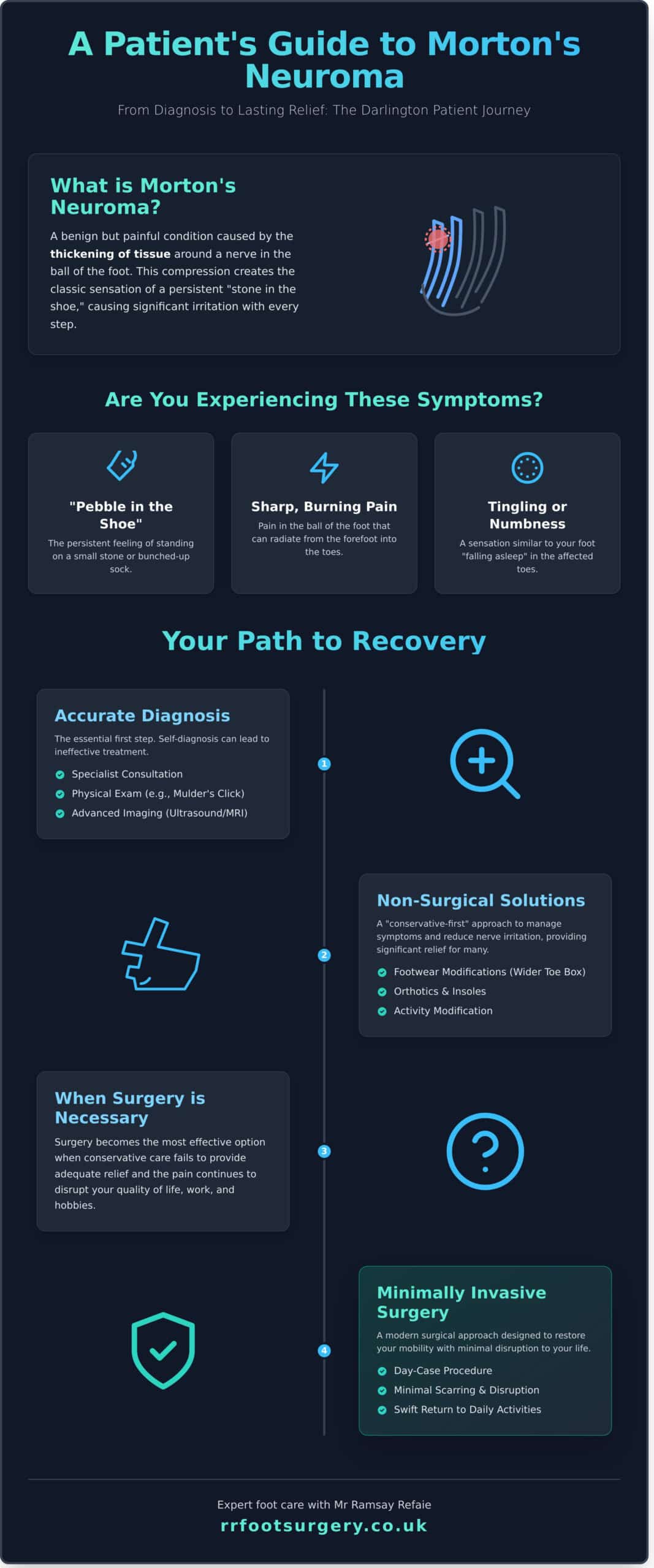
Experiencing sharp, persistent pain in the ball of your foot can be debilitating. For many active residents in and around Darlington, this discomfort is often described as feeling like there’s a small stone or a fold in their sock they just can’t smooth out. This classic sensation is a primary indicator of Morton’s neuroma, a benign but painful condition involving the thickening of tissue around one of the nerves leading to your toes. This compression most frequently occurs on the interdigital nerve between the third and fourth metatarsals, causing significant irritation and pain with every step.
To better understand this condition and some initial management strategies, this short video provides a helpful overview:
While the condition itself isn’t life-threatening, ignoring the initial signs can lead to progressive nerve irritation and, eventually, permanent damage. The thickening nerve becomes more inflamed over time, making symptoms more intense and constant. This is why seeking a timely and accurate diagnosis is the first crucial step toward effective Morton’s neuroma treatment Darlington. Early intervention can prevent the condition from dictating your lifestyle, allowing you to return to walking the dog along the River Skerne or enjoying the local countryside without pain.
Common Symptoms and Red Flags
The symptoms of Morton’s neuroma are distinct and tend to worsen with specific activities or footwear. Patients often report:
- A sharp, burning pain in the ball of the foot that may radiate into the toes.
- Tingling or numbness in the affected toes, similar to the sensation of a foot “falling asleep.”
- The persistent feeling of standing on a pebble or a bunched-up sock.
This pain is often exacerbated by wearing tight or high-heeled shoes. For those enjoying North Yorkshire’s rural life, even practical footwear like walking boots or wellingtons can compress the forefoot and aggravate the nerve. It’s vital to distinguish this nerve-related pain from other conditions; a stress fracture typically presents with more localised bone tenderness and swelling, while metatarsalgia is often a more generalised, aching pain across the ball of the foot.
Why Professional Diagnosis is Essential
Self-diagnosing foot pain can lead to ineffective, frustrating cycles of treatment. While ‘off-the-shelf’ pads and insoles may offer temporary cushioning, they rarely address the underlying nerve compression with the precision required for lasting relief. A specialist consultation provides the clinical accuracy needed to create a successful treatment plan. For a deeper clinical background, the resource for Understanding Morton’s Neuroma offers a comprehensive overview, but it cannot replace a physical examination.
During your consultation, a physical assessment, including a manoeuvre known as ‘Mulder’s Click’ test, can often identify the presence of a neuroma. To confirm the diagnosis and determine the precise size and location of the nerve thickening, Mr. Refaie utilises advanced diagnostic imaging such as high-resolution Ultrasound or an MRI scan. This detailed information is fundamental to planning the most appropriate and effective Morton’s neuroma treatment in Darlington, ensuring your care is tailored specifically to your foot’s anatomy and the severity of your condition.
Non-Surgical Morton’s Neuroma Treatment Options in Darlington
At RR Foot Surgery, our philosophy is firmly rooted in a conservative-first approach. Mr. Ramsay Refaie believes that the most effective treatment plan is often the least invasive one, reserving surgery for when it is genuinely necessary. For many patients, significant relief from the sharp, burning pain of a Morton’s neuroma can be achieved without the need for an operation. This patient-centred strategy focuses on managing your symptoms, reducing nerve irritation, and allowing you to maintain your active lifestyle with minimal disruption or downtime.
The initial steps are often practical and remarkably effective. Simple footwear modifications, such as switching to shoes with a wider toe box and avoiding high heels, can immediately reduce the compression on the forefoot nerves. For the active communities across Darlington and North Yorkshire who enjoy walking and running, activity modification is key. This doesn’t mean stopping your favourite activities; it means adjusting them intelligently to reduce repetitive stress on the ball of the foot while the inflammation subsides.
Steroid Injection Therapy: Fast-Acting Relief
For patients experiencing acute flare-ups, a corticosteroid injection can provide rapid and powerful relief. This treatment involves injecting a small amount of anti-inflammatory medication directly around the affected nerve. The procedure is performed in our Darlington clinic, takes only a few minutes, and reduces both the inflammation and the physical volume of the nerve tissue. For smaller neuromas, studies show that a single injection can provide significant relief for up to 70% of patients, often lasting for several months and sometimes resolving the issue completely.
The Role of Gait Analysis and Orthotics
Understanding why the nerve is being compressed is fundamental to long-term success. A comprehensive gait analysis reveals the precise mechanics of your foot, identifying abnormal pressure points. Based on this assessment, specialist-recommended orthotics can be prescribed. Unlike generic, over-the-counter insoles, these devices are designed to redistribute pressure away from the metatarsal heads, preventing the nerve from being ‘pinched’ with every step. While these methods are highly effective, some persistent cases may require a different approach. The American Academy of Orthopaedic Surgeons provides a detailed overview of when to consider surgical options for Morton’s Neuroma. To complement this, targeted physiotherapy helps strengthen the small intrinsic muscles of the foot, providing a more stable and resilient foot structure for the future.
Exploring these non-surgical avenues is a vital first step in finding a lasting solution. A comprehensive strategy, combining several of these techniques, forms the cornerstone of effective Morton’s neuroma treatment in Darlington. Understanding the unique biomechanics of your foot is the key to creating a personalised plan. To see how we identify the precise cause of your discomfort, you can explore our diagnostic and consultation process and begin your journey toward pain-free movement.
When Surgery is Necessary: Excision vs. Conservative Care
The thought of surgery often brings a primary concern to the forefront: “Will I regret it?” This is a valid question, especially after you’ve already invested time and hope in conservative treatments. At our Darlington clinic, we view surgery not as a last resort, but as a definitive, planned solution for patients whose condition meets specific criteria. It’s about moving from managing chronic pain to eliminating its source, allowing you to reclaim your active lifestyle with confidence.
The transition to a surgical discussion typically occurs when conservative methods no longer provide adequate relief. Key indicators include a neuroma diagnosed via ultrasound as being larger than 5mm, or when a course of at least two steroid or alcohol injections has failed to produce lasting results. These factors suggest the nerve irritation has become a permanent structural problem that is unlikely to resolve on its own.
The Decision Framework: Choosing Your Path
Your journey towards relief is personal. It depends on your symptoms, your lifestyle, and your long-term goals. For an active individual, a runner, or someone whose job requires being on their feet all day, the limitations imposed by a persistent neuroma are unacceptable. In these cases, a permanent surgical fix is often the most practical path forward. The table below offers a clear guide to help you understand the recommended approach based on your situation.
| Symptom Severity & History | Recommended Treatment Path |
|---|---|
| Mild to Moderate Pain: Intermittent symptoms, relieved by changing footwear or rest. Neuroma size under 4mm. | Conservative Care: Orthotics, footwear modification, activity adjustment, and potentially a single steroid injection. |
| Moderate to Severe Pain: Persistent pain that limits daily activities. Neuroma is 5mm or larger, or has failed to respond to two injections. | Surgical Consultation: A neurectomy is strongly considered as the most effective long-term solution. |
| High-Impact Lifestyle: An athlete or highly active individual with persistent symptoms, regardless of size, who cannot tolerate activity modification. | Expedited Surgical Consideration: Surgery is often the most efficient route to return to full, pain-free activity. |
A common patient concern is the risk of a ‘recurrent’ or ‘stump’ neuroma, where the nerve ending becomes irritated post-surgery. This risk is significantly minimised by the surgeon’s meticulous technique. Mr. Ramsay Refaie’s extensive experience ensures the nerve is transected cleanly and placed in a deep, protected tissue plane, reducing the chance of future irritation to less than 5% of cases.
Understanding Morton’s Neuroma Excision
The definitive surgical procedure for this condition is a neurectomy. This involves carefully removing the affected segment of the nerve that has become thickened and painful. As explained by the Cleveland Clinic on Morton’s Neuroma, this procedure effectively removes the source of the pain signals. The trade-off is a small, well-defined area of permanent numbness on the sides of the adjacent toes. For over 90% of patients, this numbness is a minor sensation that is vastly preferable to the debilitating, sharp pain they previously endured.
Mr. Refaie exclusively uses a dorsal approach, making a small incision on the top of the foot. This minimally invasive philosophy is central to providing the best Morton’s neuroma treatment Darlington patients can receive. This technique avoids placing a scar on the weight-bearing sole of the foot, leading to a more comfortable recovery, a lower risk of scar tissue problems, and a much faster return to wearing normal shoes. It is a modern, patient-focused approach designed for optimal outcomes and minimal disruption to your life.
The Surgical Journey: Minimally Invasive Care in Darlington
Deciding on surgery is a significant step, but modern orthopaedic techniques have transformed the experience. For patients seeking definitive Morton’s neuroma treatment Darlington, the journey is defined by precision, efficiency, and personalised care. At leading local private facilities like BMI Woodlands Hospital, your procedure is managed entirely by a dedicated consultant from your first appointment to your final follow-up. This continuity of care ensures you are always in expert hands.
The surgery itself is performed as a ‘Day Case’ procedure. This means you arrive at the hospital, have your operation, and are able to return to the comfort of your own home on the same day. This approach minimises disruption to your life and leverages advanced, minimally invasive methods that are both highly effective and safe, promoting a smoother, quicker recovery.
What to Expect on the Day of Surgery
Your surgical day is structured for comfort and clarity. Upon admission, you’ll be settled in and meet with both your consultant and the anaesthetist to discuss the plan. The procedure is typically performed under a general anaesthetic or local anaesthetic with sedation, depending on your personal preference and medical suitability. The neurectomy, or removal of the affected nerve, is a precise operation that usually takes only 20 minutes to complete. Immediately after, your foot will be protected in a thick ‘wool and crepe’ bandage, and you’ll be able to walk with the aid of a special post-operative shoe. Most patients return to light activity within 14 days of neurectomy.
Recovery Timeline and Aftercare in North Yorkshire
A successful outcome depends on a structured and well-managed recovery. Your aftercare plan is designed to restore function safely and get you back to the activities you love. The timeline is generally predictable:
- Weeks 1-2: The primary focus is on rest and elevation to control swelling. You’ll keep the surgical site dry and protected. Your first follow-up appointment is typically scheduled between 10 and 14 days post-surgery to remove sutures and assess your initial healing.
- Weeks 2-6: Once the incision has healed, you can transition from the post-operative shoe to your own wide, comfortable footwear, such as trainers. You will be guided on how to gradually increase weight-bearing and begin gentle mobilisation exercises to restore your foot’s natural movement.
- Long-Term (6+ weeks): Your return to normal activities is progressive. You can often resume driving after 2-3 weeks, once you feel confident in performing an emergency stop. A return to a desk-based job may be possible within two weeks, while more manual roles require a longer period. For those eager to return to regional pastimes, planning a hike across the North York Moors is a realistic goal from 12 weeks onward, allowing full strength and comfort to be restored.
This patient-focused surgical pathway ensures you receive the highest standard of care right here in the North East. To understand your personal surgical pathway and recovery plan, schedule your comprehensive consultation with Mr Ramsay Refaie Foot and Ankle Surgeon today.
Expert Foot Care with Mr Ramsay Refaie: Restoring Your Mobility
Living with the persistent, sharp pain of Morton’s neuroma can feel like an endless challenge, limiting your daily activities and diminishing your quality of life. You’ve learned about the condition, its symptoms, and the various treatment paths available. Now, it’s time to take the definitive step towards lasting relief. Choosing the right specialist is the most critical part of your journey, and in Darlington, that choice leads to a surgeon dedicated not just to clinical excellence, but to your complete recovery.
Mr Ramsay Refaie and the RR Foot Surgery team offer a patient-first approach, combining advanced surgical techniques with a genuine commitment to your wellbeing. We understand that foot pain is deeply personal. It affects your work, your hobbies, and your confidence. Our entire process is designed to address your unique needs, providing a clear, supportive, and effective path back to an active, pain-free lifestyle.
Why Choose Mr Ramsay Refaie?
With over 15 years of dedicated experience as a consultant trauma and orthopaedic surgeon, Mr Refaie brings a profound level of expertise to every consultation. His specialisation in complex foot and ankle conditions, honed through extensive training and practice, ensures you receive a diagnosis and treatment plan grounded in deep anatomical knowledge. This isn’t just about addressing the neuroma; it’s about understanding the intricate biomechanics of your foot to ensure the best possible long-term outcome.
This clinical expertise is matched by an unwavering focus on empathetic patient care. We believe a successful procedure involves more than technical skill. It requires listening to your story, understanding your lifestyle goals, and building a foundation of trust. Your concerns are heard, your questions are answered, and you remain an active partner in your own healthcare decisions from the initial consultation through to your final recovery. Accessing this level of care is straightforward, with options available for patients using private medical insurance or through transparent, fixed-price self-pay packages.
Booking Your Consultation in Darlington
Getting expert help for your Morton’s neuroma is convenient and accessible. Mr Refaie holds regular private clinics at premier local facilities, including BMI Woodlands Hospital in Darlington, as well as other locations across the Tees Valley. This regional presence means you can access elite-level care without the need for extensive travel.
The referral process for private patients is simple. Your GP can provide a referral letter, or you can contact our practice directly to enquire about booking if your insurance policy allows. Our administrative team is on hand to guide you through the necessary steps, making the process as smooth and stress-free as possible. Don’t let foot pain dictate your life for another day. Take control of your recovery and start your journey back to full mobility.
Your search for a definitive solution to Morton’s neuroma can end here. By choosing a dedicated foot and ankle specialist, you are investing in a precise diagnosis, a tailored treatment plan, and a supportive recovery process. It’s time to stop managing pain and start eliminating it. Book your consultation with Mr Ramsay Refaie today and take the most important step towards reclaiming the active, comfortable life you deserve.
Begin Your Journey to Lasting Foot Relief in Darlington
Living with the sharp, burning pain of Morton’s neuroma can significantly impact your daily life. We’ve explored how a precise diagnosis can lead to a range of effective options, from conservative care to advanced surgical techniques. Finding the right Morton’s neuroma treatment Darlington has to offer is the crucial first step towards reclaiming your active lifestyle.
With over 15 years of experience, Consultant Orthopaedic Surgeon Mr Ramsay Refaie is a specialist in minimally invasive foot surgery. He provides expert consultations at BMI Woodlands Hospital, offering a clear and compassionate pathway to recovery. His focus is on restoring your mobility while minimising discomfort and downtime.
You don’t have to live with the pain. Take the decisive step towards relief today. Schedule your specialist foot assessment in Darlington and discover how expert care can help you walk away from discomfort for good.
Frequently Asked Questions About Morton’s Neuroma
How much does private Morton’s neuroma surgery cost in Darlington?
The cost for private Morton’s neuroma surgery typically ranges from £3,500 to £4,500. This is an all-inclusive package price, meaning it covers the surgeon’s and anaesthetist’s fees, hospital costs, and one post-operative follow-up appointment. We believe in complete transparency, so you will receive a detailed, fixed-price quotation following your initial consultation, ensuring there are no unexpected expenses during your recovery journey.
Can Morton’s neuroma go away on its own without treatment?
No, a true Morton’s neuroma will not resolve on its own. The condition involves a physical thickening of the nerve tissue, which is permanent without intervention. While changing footwear or using orthotics can sometimes alleviate symptoms temporarily, the underlying problem remains. Lasting relief almost always requires professional medical treatment to address the affected nerve directly and restore your foot’s function.
Is a steroid injection for neuroma painful?
The procedure involves some initial discomfort, but it’s managed to be as minimal as possible. Before the steroid is administered, we apply a local anaesthetic to thoroughly numb the area. Most patients report feeling a brief sting from the anaesthetic, followed by a sensation of pressure during the actual injection, which lasts less than a minute. The goal is to trade a moment of discomfort for weeks or months of significant pain relief.
How long is the waiting list for private foot surgery in North Yorkshire?
One of the primary benefits of private care is rapid access to treatment. Typically, you can secure an initial consultation within one to two weeks of your enquiry. If surgery is deemed the appropriate course of action, the procedure itself can usually be scheduled within the following two to four weeks. This efficient timeline allows you to address your pain and begin your recovery without the lengthy delays often experienced elsewhere.
Will I be able to drive after Morton’s neuroma excision?
Your ability to drive depends on which foot was operated on and your vehicle type. If you had surgery on your left foot and drive an automatic car, you may be able to resume driving within a week. However, if the surgery was on your right foot, you must refrain from driving for at least 2 to 4 weeks. It’s essential to be able to perform an emergency stop safely and to check your motor insurance policy.
What are the risks of leaving a neuroma untreated?
Leaving a neuroma untreated often leads to a progressive worsening of pain, which can become chronic and severely limit your daily activities and footwear choices. Over time, the persistent nerve irritation can cause permanent numbness in the affected toes. Seeking a definitive Morton’s neuroma treatment in Darlington is crucial to prevent this deterioration and avoid the development of compensatory issues in your gait, which can affect your ankle, knee, and hip.
Does Bupa or AXA cover Morton’s neuroma treatment with Mr Rees?
Yes, Mr. Richard Rees is a recognised specialist with all major private medical insurers, including Bupa and AXA. To ensure your treatment is covered, you must contact your insurer before your initial consultation to confirm your policy details and obtain a pre-authorisation number. Our administrative team is experienced in this process and can provide any necessary information your insurer requires to facilitate a smooth and straightforward experience.
Can I wear high heels again after neuroma surgery?
Yes, it’s often possible to wear high heels again following a successful recovery. We generally advise patients to wait a minimum of three months post-surgery before reintroducing them. It’s best to view heels as occasional wear for special events rather than daily footwear. This approach helps protect the surgical site, prevents recurrence, and supports the long-term health and comfort of your feet, allowing you to enjoy a full return to your preferred lifestyle.