Discover the advanced surgical and non-surgical options for correcting foot deformities in North Yorkshire, guided by the expertise of Mr Ramsay Refaie. Living with a foot deformity can be a source of constant pain and frustration, impacting everything from your choice of footwear to your ability to enjoy a simple walk. For many in the Tees Valley, the prospect of restoring comfort and mobility is a primary concern. Fortunately, modern orthopaedic care offers a range of sophisticated solutions tailored to your specific condition and lifestyle, moving beyond traditional methods to focus on effective results and a smoother recovery.
This guide will walk you through the types of foot deformities treated locally, the advanced corrective techniques available, and what you can expect from the treatment journey with a specialist Consultant Orthopaedic Surgeon.
Common Foot Deformities Treated in North Yorkshire and Darlington
Foot deformity correction encompasses a range of specialised surgical and non-surgical procedures designed to realign the bones, ligaments, and tendons of the foot. The goal is to restore correct anatomical structure, alleviate pain, improve function, and enhance the foot’s appearance. Mr Ramsay Refaie commonly treats several conditions affecting patients across North Yorkshire.
- Hallux Valgus (Bunions): A prominent bony bump that forms on the joint at the base of your big toe. This can cause the big toe to point inwards, leading to significant pain, pressure, and difficulty fitting into shoes.
- Lesser Toe Deformities: This category includes conditions like hammer, claw, and mallet toes, where the smaller toes become bent into an abnormal, fixed position. This often results from muscle imbalance and can cause painful corns and calluses.
- Pes Planus (Flat Feet): In adults, this often refers to ‘acquired flat foot’, where the arch of the foot collapses. This can lead to pain in the arch, heel, and even the ankle, affecting balance and walking endurance.
- Pes Cavus (High Arches): A less common condition where the arch of the foot is unusually high. This can place excessive stress on the ball and heel of the foot, causing pain and instability.
Identifying Your Foot Condition
Recognising the early signs of a developing foot deformity is key to seeking timely and effective treatment. You should consider a specialist assessment if you notice:
- Visual Cues: A visible bump forming at the base of the big toe, toes that are starting to curl or cross over, or a noticeable flattening of your arch when you stand.
- Functional Symptoms: Persistent pain that worsens with activity, such as walking around Darlington town centre or standing for long periods. You may also experience swelling, stiffness, or difficulty finding shoes that don’t cause irritation.
- Footwear Impact: If your shoes wear down unevenly or you find yourself constantly needing wider fittings to accommodate changes in your foot shape, it may indicate an underlying structural issue.
The Importance of Specialist Diagnosis
While common, foot deformities are complex conditions that require an expert diagnosis to ensure the correct treatment path is chosen. A Consultant Orthopaedic Surgeon, like Mr Ramsay Refaie, possesses the specialised training to differentiate between structural deformities and issues like temporary inflammation.
During a consultation at a local Tees Valley facility, a thorough physical examination is combined with advanced imaging, such as X-rays or MRI scans. This detailed assessment provides a clear picture of your unique anatomy, allowing for a precise diagnosis and the development of a personalised treatment plan.
Advanced Techniques for Foot Deformity Correction in the Tees Valley
Modern foot and ankle surgery has evolved significantly, with an emphasis on techniques that are not only effective but also designed to optimise patient recovery. Mr Refaie employs a range of advanced procedures to achieve the best possible outcomes.
- The Philosophy of Minimally Invasive Foot Surgery (MIFS): This approach uses very small incisions to perform corrective procedures, which can lead to less soft tissue damage and a quicker recovery.
- Osteotomy: This is a precision surgical technique that involves cutting and realigning bone. It is a cornerstone of correcting deformities like bunions and flat feet, restoring the foot’s natural alignment.
- Soft Tissue Reconstruction: For many deformities, addressing the ligaments and tendons is just as important as realigning the bones. Procedures can include tendon transfers and ligament repairs to restore stability and function.
- Arthrodesis (Joint Fusion): In cases of severe deformity or advanced arthritis, fusing a joint can be the most reliable way to eliminate pain and create a stable, correctly aligned foot for walking.
Modern Surgical Approaches vs. Traditional Methods
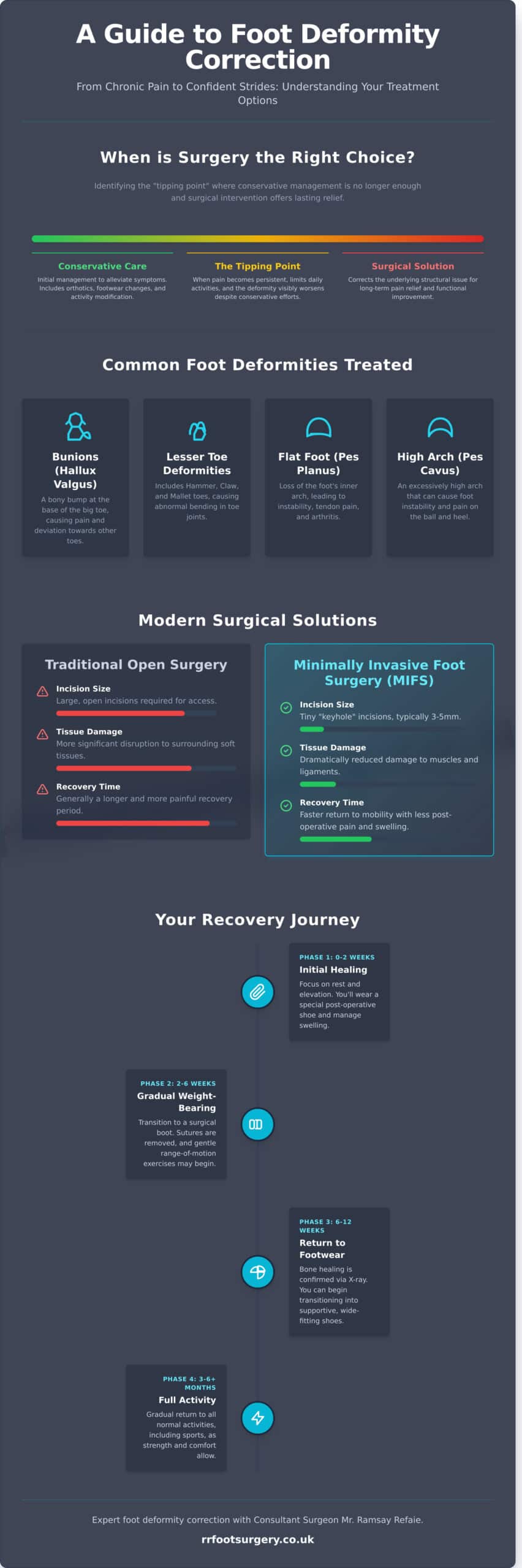
The evolution of foot surgery has moved towards techniques that minimise surgical trauma and accelerate healing. While traditional "open" surgery remains an important option for certain complex cases, many modern procedures, including minimally invasive techniques, offer distinct advantages. By using smaller incisions, surgeons can reduce the risk of infection and minimise visible scarring. This less disruptive approach often results in less post-operative pain and swelling, which can contribute to faster healing times. For patients, this may mean a quicker return to daily activities and work. Many of these advanced procedures can be performed as day-case surgery under local anaesthetic at facilities like BMI Woodlands Hospital, offering greater convenience.
Innovative Solutions for Flat Feet
Adult-acquired flat foot is a progressive condition that can cause significant pain and disability if left untreated. Modern reconstructive surgery offers a reliable solution to restore the foot’s natural arch and function. This is often a complex procedure involving several techniques tailored to the individual. A medial displacement calcaneal osteotomy, for example, involves repositioning the heel bone to correct alignment. This is frequently combined with tendon reconstruction, where a damaged or stretched tendon (typically the tibialis posterior) is repaired or reinforced to provide active support for the newly restored arch.
Surgical vs. Non-Surgical Correction: Making the Right Choice
Deciding on the best course of action for your foot deformity is a collaborative process between you and your surgeon. While surgery is a powerful tool, it is not always the first or only option.
In the early stages of a condition, or for less severe deformities, conservative management is often the first line of treatment. However, there is often a "tipping point" where the pain and functional limitation caused by the deformity begin to significantly impact your quality of life. At this stage, surgery becomes the most effective path forward. It is a misconception that foot surgery should always be a "last resort." In fact, delaying necessary surgical correction can sometimes allow the deformity to worsen, potentially leading to secondary problems like arthritis in adjacent joints.
Conservative Options in North Yorkshire
Before considering surgery, several non-invasive treatments can be explored to manage symptoms:
- Custom Orthotics: Medically prescribed insoles can help to support the foot, redistribute pressure, and alleviate pain, though they do not correct the underlying structural deformity.
- Steroid Injection Therapy: For painful joints or inflammation, a targeted steroid injection can provide powerful, immediate pain relief, helping to break the cycle of inflammation.
- Physical Therapy: Specialist physiotherapy, widely available across Middlesbrough and Stockton, can help strengthen supporting muscles and improve flexibility, which can be beneficial in managing certain conditions.
The Surgical Decision Framework
The decision to proceed with surgery is made after careful consideration of your individual circumstances. During your initial consultation with Mr Ramsay Refaie, the discussion will focus on:
- Evaluating Quality of Life: How much is the deformity affecting your daily activities, work, and hobbies?
- Personalised Treatment Plans: The recommended procedure will be tailored to your specific diagnosis, age, and activity level to ensure the outcome meets your personal goals.
- Understanding the Process: You will receive a clear, honest explanation of the proposed surgery, the potential risks, and the expected recovery, empowering you to make a fully informed decision about your care.
Recovery and Aftercare: What to Expect Post-Surgery
A successful outcome depends not only on the surgery itself but also on a well-managed recovery and rehabilitation period. Mr Refaie and his team provide comprehensive guidance to support you every step of the way.
The first 48 hours are focused on managing pain with prescribed medication and keeping the foot elevated to control swelling. Your weight-bearing timeline will depend on the specific procedure performed; you will typically progress from a surgical boot or cast to supportive footwear over a period of several weeks. Physical therapy is a crucial component of recovery, helping to restore your foot’s strength, range of motion, and flexibility. For most patients, modern foot deformity correction has very high success rates, leading to lasting pain relief and functional improvement.
Your Recovery Timeline
While every patient’s journey is unique, a general timeline can help set expectations:
- Week 1-2: Focus is on rest, elevation, and wound care. You will have a follow-up appointment to check the initial healing.
- Week 6: Depending on the procedure, you may begin transitioning from a surgical boot into a supportive shoe.
- Month 3-6: Most patients can gradually return to more demanding activities, including low-impact sports. A full return to high-impact sports may take longer.
Local Aftercare in Darlington and Northallerton
Your post-operative care is conveniently managed close to home. Follow-up appointments can be scheduled at clinics like the Friarage Hospital in Northallerton or Nuffield Health Tees Hospital. We can also connect you with trusted local physiotherapy networks to guide your rehabilitation. Adhering to the post-operative care plan is the single most important factor in achieving a successful long-term outcome.
Expert Foot Deformity Correction with Mr Ramsay Refaie
With over 15 years of dedicated experience as a specialist Consultant Orthopaedic Surgeon, Mr Ramsay Refaie is a leading expert in foot and ankle conditions in the Tees Valley. He is committed to providing patient-centered care, ensuring that you feel heard, understood, and confident in your treatment from the initial diagnosis through to your final rehabilitation.
Mr Refaie holds consultations across the region, with clinics conveniently located in Middlesbrough, Darlington, and Stockton, making expert care accessible to patients throughout North Yorkshire and County Durham.
Private Treatment Benefits
Choosing private care for your foot deformity correction provides several key advantages:
- Avoid NHS Wait Times: Gain rapid access to consultation and surgery, allowing you to address your pain without delay.
- Choice of Hospital: Select the facility that is most convenient for you, with procedures performed at BMI Woodlands Hospital, Nuffield Health Tees Hospital, or Tees Valley Hospital.
- Direct Consultant-Led Care: You will be under the direct care of Mr Ramsay Refaie throughout your entire journey, ensuring continuity and the highest standard of expertise.
Booking Your Consultation
Accessing private care is straightforward. We accept patients with private medical insurance from major providers like Bupa and AXA, as well as those who wish to self-fund their treatment through transparent, fixed-price packages. To begin your journey towards pain-free mobility, please contact our team to arrange your initial appointment at one of our Darlington or Middlesbrough clinics.
Schedule a Private Consultation in North Yorkshire
Frequently Asked Questions
How long is the recovery time for foot deformity surgery?
Recovery varies depending on the specific procedure. Minor soft tissue procedures may allow a return to normal shoes in 2-3 weeks, while more complex bone realignment (osteotomy) can require 6-8 weeks in a surgical boot before transitioning to regular footwear. Full recovery and a return to all activities can take 6-12 months.
Will I be able to walk immediately after the procedure?
This depends on the surgery. For many procedures, you will be able to walk on your heel or in a special surgical boot immediately. For more extensive reconstructions, a short period of non-weight-bearing with crutches may be required to protect the repair.
Is foot deformity correction covered by private medical insurance?
Yes, most major private medical insurance providers cover surgery for symptomatic foot deformities like bunions and flat feet. It is always best to check with your provider and obtain an authorisation code before your consultation.
What are the risks associated with modern foot surgery?
All surgery carries risks, including infection, blood clots, nerve injury, and stiffness. However, with modern techniques and careful patient selection, these risks are low. Mr Refaie will discuss all potential risks with you in detail during your consultation.
Can flat feet be permanently corrected in adults?
Yes, adult-acquired flat foot can be permanently corrected with reconstructive surgery. The goal of the surgery is to realign the bones and repair the tendons to restore a stable, functional arch, providing lasting pain relief and improved mobility.
How much does private foot deformity surgery cost in North Yorkshire?
The cost depends on the complexity of the procedure, the hospital chosen, and the length of stay required. We provide transparent, all-inclusive self-pay package prices following your initial consultation, which cover surgeon’s fees, anaesthetist’s fees, and hospital costs.
What happens if I leave a foot deformity untreated?
If left untreated, most structural foot deformities are progressive. This means they can worsen over time, leading to increased pain, greater difficulty with footwear, and the development of secondary arthritis in the foot and ankle. Early intervention often leads to better long-term outcomes.